

















![[ERROR]: Lack of Women in the Software Industry](https://theechohsmse.com/wp-content/uploads/2024/12/APC_0280-984x1200.jpeg)




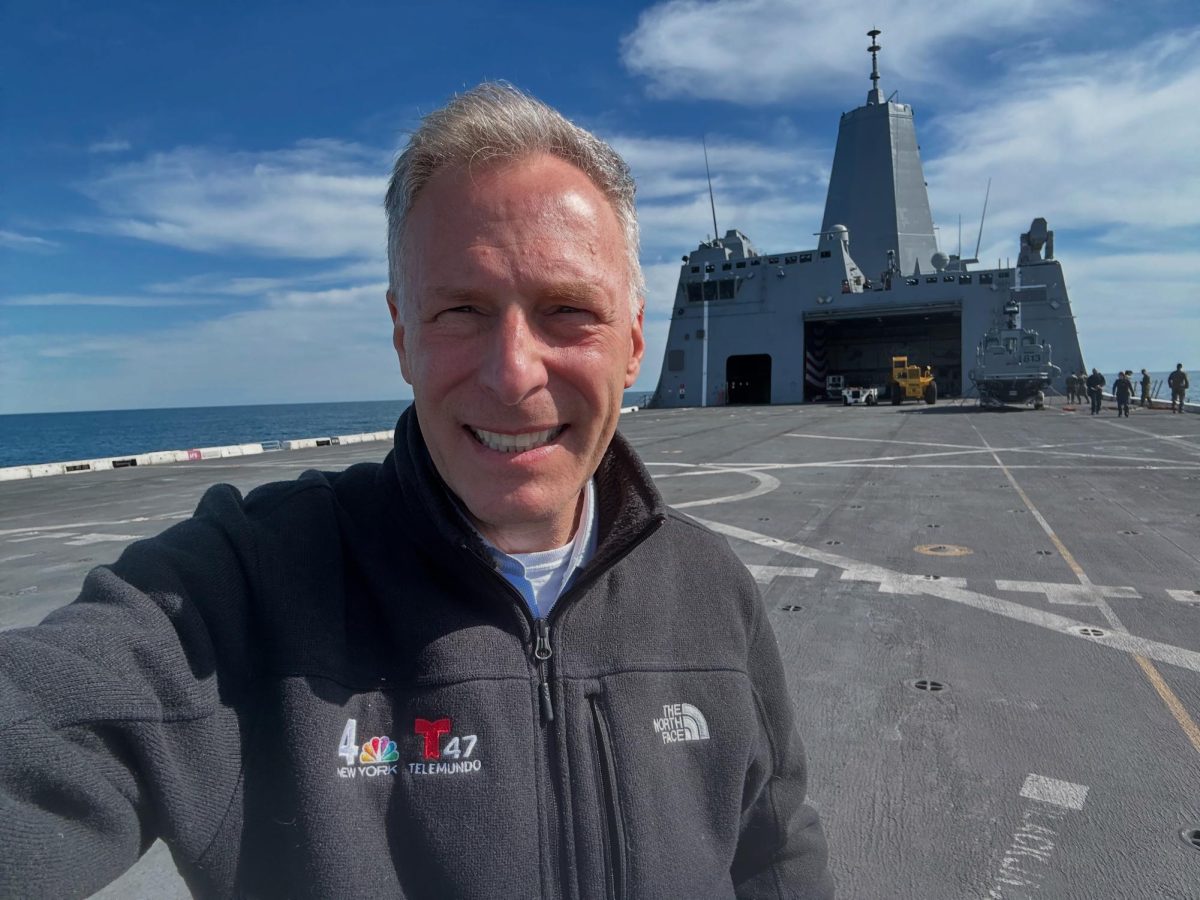
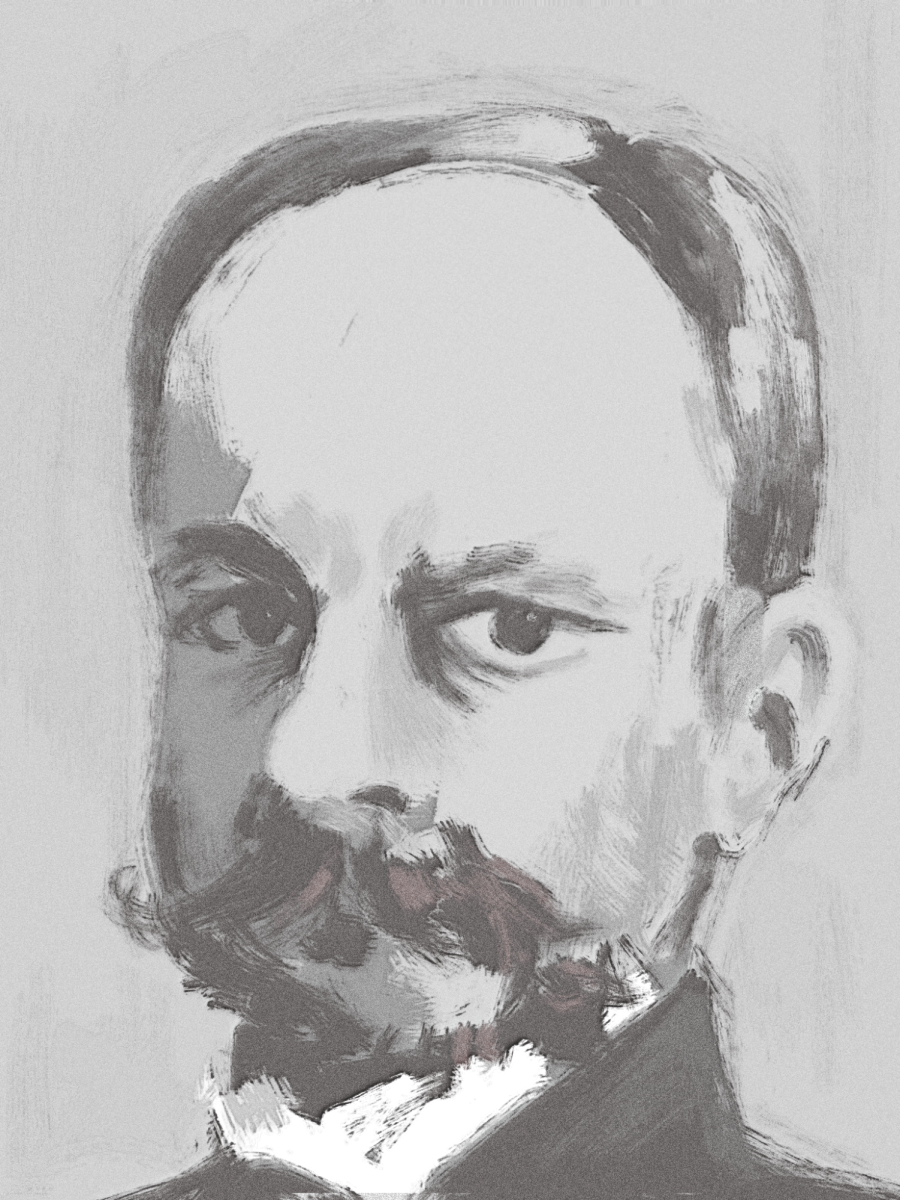
Every weekday, Michael Gargiulo wakes up at 2:00 a.m. He has reinvented his sleep schedule to anchor WNBC’s “Today in New York” since 2008—longer than many HSMSE students have been alive. And you’re still coming to school late?
If you go to channel 4 between 4:30 and 7:00 a.m., you’ll see Gargiulo announcing the latest breaking news across the five boroughs. His career in broadcast journalism has also taken him to 20 countries and territories around the world and won him six Emmy Awards. The Echo was incredibly honored to interview Gargiulo about his journey.
A native New Yorker, Gargiulo attended Xavier High School and was involved in their student newspaper. His drive to explore the world and communicate its stories began early; he double-majored in history and German at New York University. However, it wasn’t until after graduating and working a series of odd jobs that didn’t quite click that Gargiulo began to seriously consider pursuing journalism.
“[I went to] an old-fashioned career counselor on 14th Street and 6th Avenue,” he said. There, the counselor spotted his extroverted nature and curiosity for the world and told him he should become a newscaster.
Gargiulo had no experience in television at the time. Regardless, he cobbled together a videotape exhibiting his ambitions and sent it to 100 newsrooms across the United States, he said.
After many rejections, he finally received an offer from WSAZ-TV in Huntington, West Virginia in 1984. Since Gargiulo had only ever lived in bustling New York City, the move was a massive culture shock. But he was determined to become a reporter, no matter where.
“There were no Gargiulos in West Virginia,” he said. For the three years he worked there, WSAZ-TV had him (an Italian American) go by “Michael Louis” instead, claiming its viewers would not remember ethnic names. When he sent tapes of his reports back to his family in New York, they would have to watch him introducing himself as Michael Louis rather than Gargiulo, an experience that was disheartening to him.
Gargiulo believes the unpopularity of such a measure today “speaks to how now we are a more diverse industry and country.” In 1985, journalists of color held just over five percent of American newspaper jobs; the 2024 statistic is estimated to be 22 percent. This is still not representative of the U.S. as a whole, however, and marginalized journalists face disproportionate layoffs and burnout.
While working in West Virginia, Gargiulo continued sending stories out to publications across the country. Soon, he was hired as a reporter and news anchor for WYOU, a CBS affiliate in Scranton, Pennsylvania—a step up from West Virginia for him and closer to New York.
Gargiulo first entered the “major leagues” in 1993, when he became a reporter and news anchor for KSTP-TV in Minneapolis, a publication that owned two planes, a helicopter, and satellite trucks (the only way to connect to TV signals then). Gargiulo continued his international reporting there, attending the 50-year anniversary of D-Day in France and the flag raising at Iwo Jima—exciting experiences for a self-described military history buff. “To be able to see things and do things around the world—that meant so much to me,” Gargiulo added.
Gargiulo returned to the East Coast in 1997 as a correspondent for Hearst-Argyle Television in Washington, D.C., where he reported daily from the White House and Capitol—even receiving an invitation from President Bill Clinton to the White House Christmas party. In 2000, Gargiulo began reporting and anchoring for WTTG, the Fox channel 5 station in Washington.
At 7:00 a.m. on September 11, 2001, Gargiulo announced, as usual, “Good morning, welcome to Fox 5 morning news, it is Tuesday, I’m Michael Gargiulo.” One hour and 46 minutes later, two commercial planes crashed into the World Trade Center in New York. “No one knew what was happening—we were trying to [get our audience the information],” Gargiulo added, a testament to his and his coworker’s dedication to public service on such a tragic day in American history.
“I’m always proud to bring coverage,” Gargiulo said, “because it’s not about me; it’s about those people.”
Gargiulo remained on air all day, doing what he views as the most important reporting of his career. It was an “emotionally challenging time,” especially because most of Gargiulo’s family was still in New York City. “[9/11 impacted] me as a New Yorker, as an American, [and] as a journalist,” he said.
At last, Gargiulo was able to return to New York City to work for WNBC. There, he covered everything from the devastation left by Superstorm Sandy in 2012, to the 2018 explosion of a steam pipe in Manhattan. Through WNBC, he was able to do even more traveling to report from other countries during war, continuing to achieve his goal of supplying coverage to people amidst difficult times.
He was stationed briefly in countries including Kuwait, Iraq—reporting which he received one of four Emmy awards for—and, most recently, Afghanistan. There, Gargiulo reported on a unit within the US Army’s 10th Mountain Division, the same division that he had reported on in Iraq; he was “one of the last reporters to be embedded with a U.S. military unit in Afghanistan before the end of combat operations.”
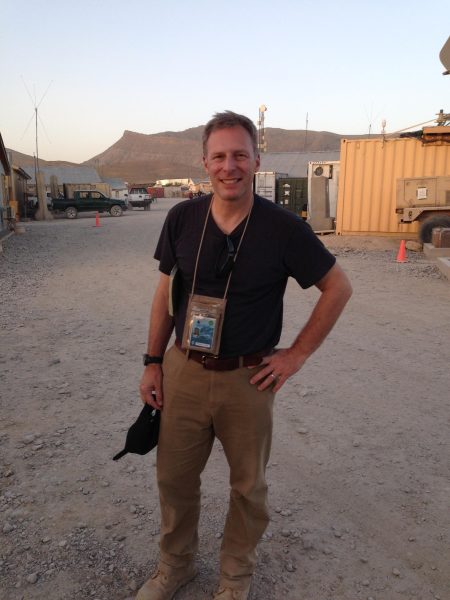
Gargiulo would venture from the base every day via helicopter and see what was happening with his own eyes. He expressed great pride in being able to work from these locations, describing the importance of reporting in person to fully understand what is happening. He recognizes that he was only in these locations for a short time, acknowledging that many other journalists are “risking everything” to do their reporting at times of war.
Gargiulo believes one way to ensure that breaking news is being addressed with utmost sensitivity and consideration for viewers is through a strong knowledge of history—one of his majors in college. He continually emphasized the importance of the context that history provides in our current world and how essential it is to remember the past.
While turning on the news is a constant routine in many people’s lives, the news itself is always evolving—in terms of the content, of course, but also the way in which it is reported.
Gargiulo explained how much more compact reporting has become; in the past, broadcast reporting required helicopters, planes, and satellite trucks, and reports were shot on film which was later cut by a razor. In 2023, Gargiulo reported on the Polish–Ukrainian border, where the backpack of one photographer contained all of the necessary equipment in order to broadcast from the site immediately.
However, evolving technology comes with complex implications. The rise of artificial intelligence has challenged many careers. Gargiulo emphasizes that we must learn to adapt to AI properly, but remains confident that AI will not replace news reporters. “Humans want to watch humans,” he said.
He alluded to Max Headroom, a robot broadcaster from the ’80s that was not received well by the public. Viewers trust reporters because of the human-to-human connection they foster; Gargiulo enjoys being a newscaster for morning television because he believes it is “part of how [viewers] relate to the world.”
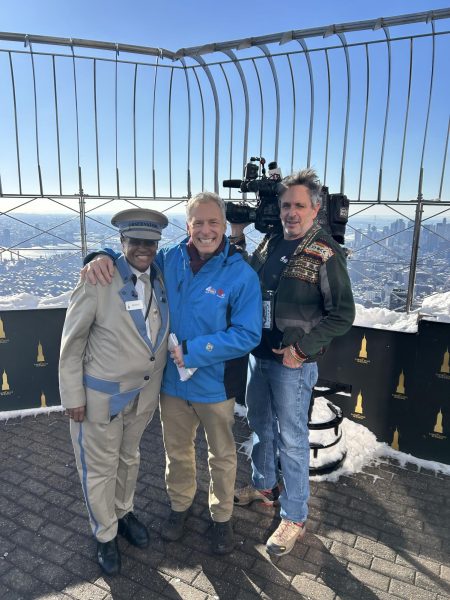
While some may know Gargiulo from WNBC’s award-winning coverage of COVID-19’s emergence, others may remember seeing him on Team Umizoomi, an early-2010s children’s television series. Naturally, Gargiulo played a news anchor, an experience he found to be a “real thrill.”
“I worked in front of a green screen and talked to a tennis ball—that’s how you do it!” he said.
Much has changed in the field of journalism within Gargiulo’s career alone—from mailing videotapes to standing in front of green screens (not just for Team Umizoomi). While it is enticing to think of what can possibly come next, thinking about the future of journalism may also be worrisome to many.
A 2025 survey by the News Literacy Project found that 84% of American teenagers view news media negatively. The few interested in pursuing journalism face declining job security, threats of political persecution, and more.
However, Gargiulo’s message to aspiring reporters was clear: “Go out, take a chance!” He advised doing as much storytelling as possible across print, podcast, and digital mediums and adapting to changes in the industry while remaining true to journalistic ethics. The key to jobs, he said, is seeking internships and personal connections.
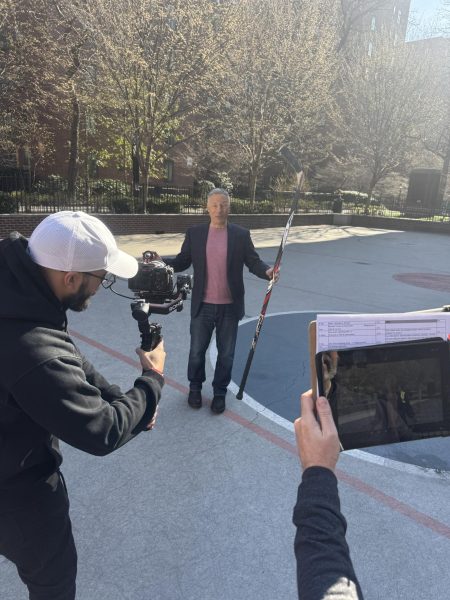
“Look at everything you do in your life as training for your career, not just journalistic courses,” Gargiulo added. He gave examples of working with children and driving a tractor. “All those little bits of knowledge,” he said, strengthen a reporter’s abilities to connect with people, understand the issues affecting them, and serve the public—advice that applies to many other careers as well.
Gargiulo said he sees broadcast journalism as similar to baseball: You have to start small before advancing to the major leagues. Thank goodness the downtown Manhattan career counselor delivered him that first, monumental pitch.