

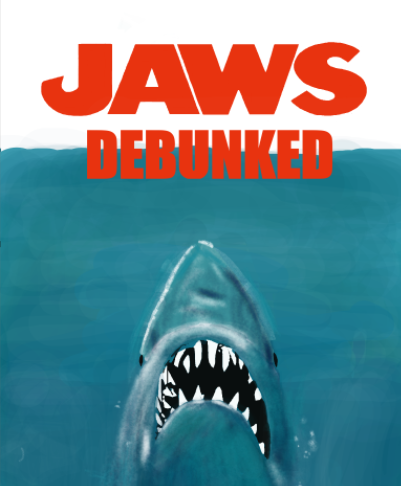
Jaws came out on June 20, 1975, and it soon became what many consider the first true summer blockbuster. The movie was directed by now-famed director Steven Spielberg. IMDb reports that the movie grossed over $490 million worldwide, and was the first movie to surpass $100 million in rentals. The suspenseful movie created a new era of mass marketing, merchandise, and a decade of long-lasting fears of swimming.
In the movie (which is based on a novel), a killer shark, specifically a great white, terrorizes the beaches of Amity, New York. The sheriff of the town teams up with a marine biologist and a grumpy fisherman to kill the great white.
The Jaws great white was 25 feet long, half the size of a basketball court, and weighed about three tons, which is as heavy as a Ford pickup truck or a white rhino. These are obviously not real measurements of great whites, which normally reach from 13 to 20 feet, and very rarely surpass 20 feet long. They also weigh over a ton less than what the movie suggests.
Unlike the movie suggests, they are not bloodthirsty animals. Sharks don’t actively hunt humans for food. According to the National Ocean Service, there are over 300 types of sharks, with eight different categories. Only about a dozen types pose a threat to humans. Sharks come in many different sizes too. The biggest shark, the whale shark, can grow to be between 23 and 66 feet long. Despite their size, whale sharks are known to have a docile nature, which means you can even see one up close without a high chance of harm. And on the opposite end of the spectrum, dwarf lantern sharks are the smallest ones. The biggest one ever found was almost eleven and a half inches long.
Now maybe you’re wondering, “Gee, if sharks don’t hunt humans, how come there are cases all around the world where sharks eat people?” First off, there are only a handful of cases where shark attacks are reported. In 2025, the Florida Museum categorized 105 shark attacks worldwide with 65 unprovoked bites on humans. Sharks diets, like any other animal’s, start to shift when there is a change of habitat, ecosystem, or when they are injured. They are tempted to hunt other creatures out of their usual diets because sharks are opportunist hunters. They eat what is available. Even if it so happens to be humans.
A common follow up question is “How come surfers get attacked?” Sharks, while having eyesight ten times as strong as humans, are bad at seeing color. Many scientists believe they might even be colorblind. A theory known as the mistaken identity theory postulates that sharks would bite prey as a test bite and, if realizing their prey isn’t actually food, will give up on their attack. Especially for great whites, whose diets consist of seals, a seal in murky waters and a human laying on their surfboard look fairly similar.
To give credit where it’s due, let’s get into what they did get correct. Sharks have incredible senses of smell. A shark, at least a carnivorous one, can smell blood over a quarter of a mile away when the tides are in its favor. Sharks can also detect prey with electroreception and high sensitivity to low frequencies. Which is why they can be more attracted to crowded beaches with the high levels of seismic activities on a beach. In a twisted way, Jaws was able to show how quick people are to villanize sharks. Yes, the shark is the villain in the movie, but in real life, sharks are rarely a threat to humans, yet when you hear “shark,” you can’t help but think of a killing machine.
Now, before you think Steven Spielberg is a villain for ruining sharks’ reputation, don’t worry. He already knows that, too. The famous director once said in an interview with BBC’s Desert Island Disc Podcast “I truly and to this day regret the decimation of the shark population because of the book and the film, I really and truly regret that.” Sharks are marvelous creatures, and movies give them a tremendous amount of bad PR. With summer coming so soon, you probably don’t want to be scared on a beach. The chances of a shark fatality are one in 4,332,817, meaning you are more likely to die from a vending machine falling on you than a shark. This isn’t meant to make you love sharks either. Just, perhaps be more conscious when you think of them. And maybe be more careful the next time you shake a vending machine.