




























![[ERROR]: Lack of Women in the Software Industry](https://theechohsmse.com/wp-content/uploads/2024/12/APC_0280-984x1200.jpeg)





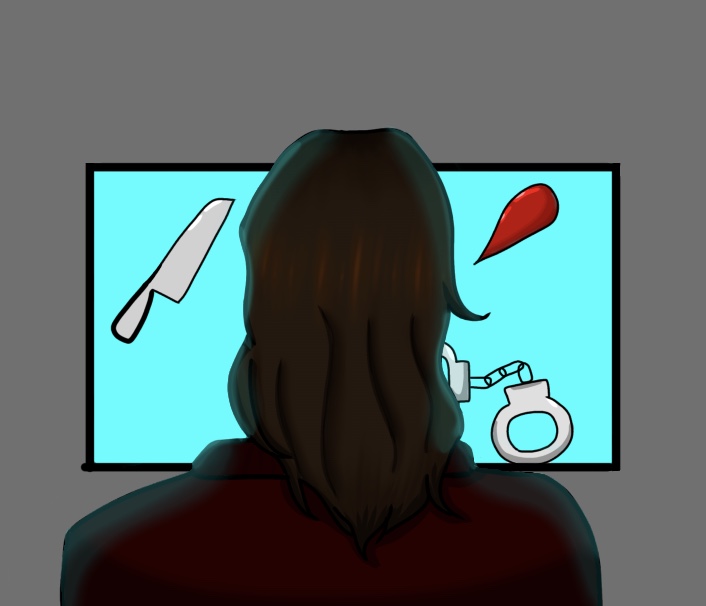
True crime—a nonfiction genre of literature, film, podcasts, etc. that depicts and examines real crime cases—has recently become a common form of entertainment. I’m sure you’ve seen it somewhere online—a murder mystery, a brutal kidnapping, an unsolved case. However, why have we as a society become so enamored with the genre?
According to an article published by The University of North Carolina at Chapel Hill, people are drawn to true crime out of a desire for justice, the “solve it yourself approach” utilized by a lot of true crime content, and a want to subconsciously prepare themselves for dangerous situations. People like watching cases get solved and feeling like they cracked it themselves, all from the comfort of their couch. Psychology Today highlights how the potential preparation aspect especially applies to women, stating, “[since women] statistically face a higher risk of violent crimes, true crime media can serve as a form of psychological rehearsal.” The article also lays out vast potential benefits to engaging with true crime content, such as improved emotional regulation, social connection, and problem solving skills.
However, in contrast to these potentially beneficial effects, an obsessive interest in true crime could have negative effects. People could become paranoid about the dangers of the world after absorbing information about all the awful, sadistic things that make up true crime. An obsession with the genre could cause people to feel more anxious about threats to their safety after witnessing these horrors from the media. Another potential issue is that the content often discloses information about the victim, the crime, and their family for anyone to see without consent. The victims and their families are still real people, and these experiences might not be something they want the entire world to know about. True crime content is also often sensationalized, with facts being distorted for profit. Criminals are elevated to statuses like those of celebrities, which can lead to biased juries if the case is still in trial. For instance, the public’s widespread interest in Ted Bundy, and his attractive depiction as Zac Efron in “Extremely Wicked, Shockingly Evil and Vile” made the public view him and his crimes glamorously and in ways that were not accurate to who he really was. There are also ethical concerns regarding the genre, such as only certain types of victims’ cases getting widespread media attention—murder cases of prostitutes, for instance, often don’t get as much coverage as those of seemingly innocent women. People of color also tend to be less represented because people have gotten so accustomed to the familiarity and repetitiveness that many true crime outlets have come to produce.
People on campus have varying opinions on the genre. Raz, who graduated from HSMSE, said, “I like the mystery.” Her friend Fatima weighed in, adding, “I like the investigative part.” Another man, Joseph, stated, “I love [true crime]—in movies it is like the concept of not knowing what will happen next, the suspense … True crime changes my perspectives on reality.” Daksh, the barista at the cafe in the NAC, agreed that he finds true crime “interesting.” Max Drill (‘27) says he likes true crime “because I think it is really interesting and unique.”
Not all responses I received were positive, however. Natalia, a CCNY student, said,“I don’t watch true crime because I heard from a study that it raises anxiety.” I also interviewed some people within our MSE community, such as Majd Alaouie (’26), who had a “neutral” opinion on true crime, as he doesn’t really watch it.
While the jury’s still out on whether or not true crime is good for the consumer or the justice system itself, it is clear that members of our community and people in general have a fondness for the genre. It is generally seen as engaging and suspenseful. Between the mystery aspect and the almost morbid interest we seem to take in these gruesome cases, people are definitely drawn to true crime content.