

























![[ERROR]: Lack of Women in the Software Industry](https://theechohsmse.com/wp-content/uploads/2024/12/APC_0280-984x1200.jpeg)





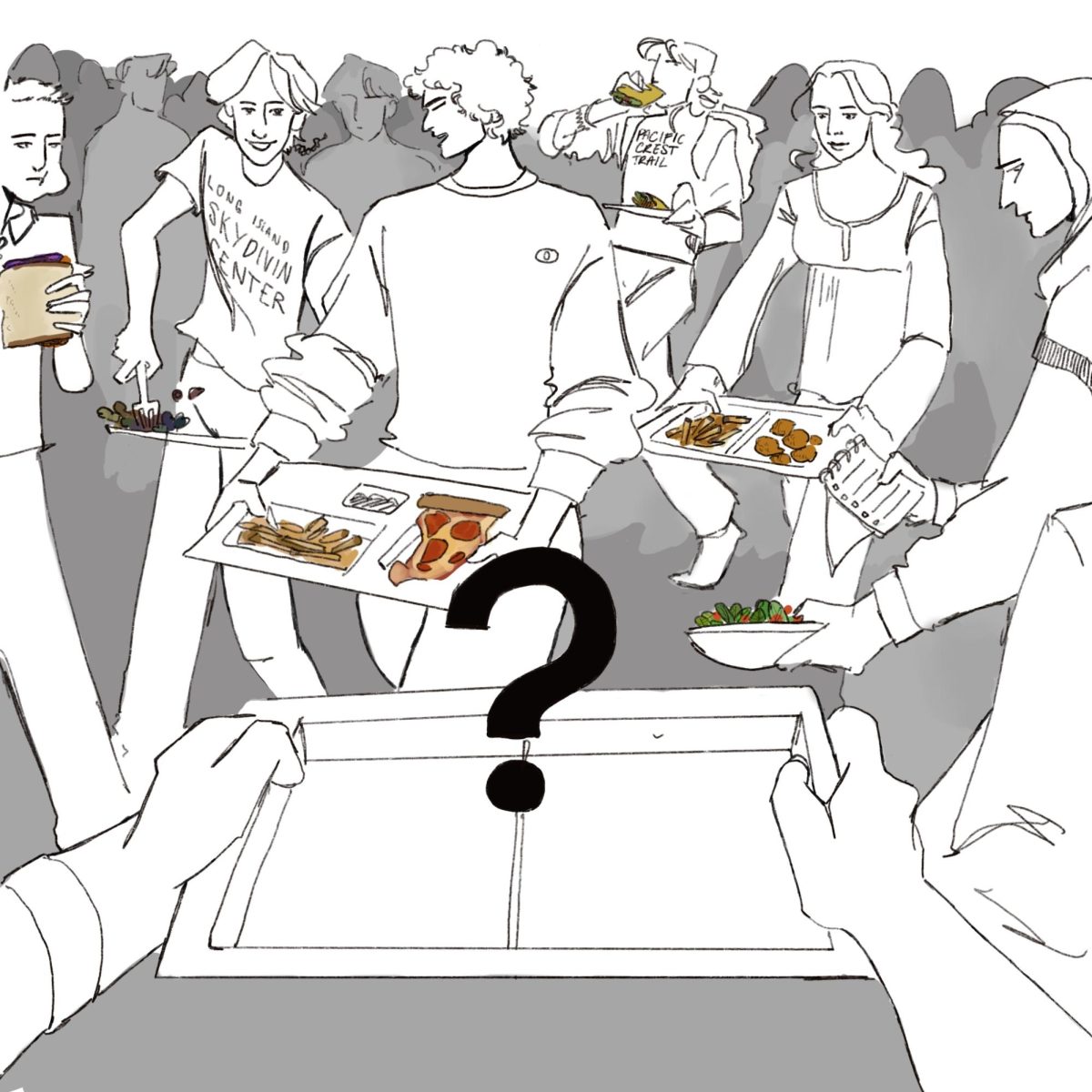
Who eats lunch alone anymore? Short answer: Since the pandemic, 45 percent of Americans do.
While it’s generally accepted in America, eating alone is considered monstrous in some cultures. “In the villages of Mueda where I worked, there was a special word for one who ate alone: nkwaukanga. Such people were traditionally condemned as greedy, even ugly,” says anthropologist Harry G. West. It’s super important: Anthropologists have found that the gang we eat with partly defines our place in society. Yet in American society, we don’t prioritize eating together. Even at my aunt’s, the kids are sluggish to come eat with us, still on Roblox while my grandparents finish their food. Or the kids don’t wanna eat because they’ve been eating Hot Pockets. What fragmented our food culture? To get a sense of the problem, I read In Defense of Food by Michael Pollan.
In short, people eating packaged foods alone is very profitable for companies like Nestlé, so they advertise solo snacking like crazy to encourage constant, unstructured eating. Thanks to that, Americans reach for a “snack” several times a day, which has made Nestlé immense profits.
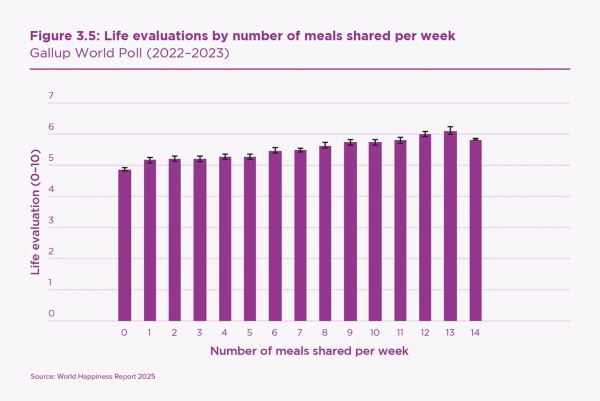
The graph above shows “life evaluation” scores of a survey conducted on 200,000 individuals on their general happiness. For reference, the average unemployed individual reported a “life evaluation” score 0.6 less than the overall average. Eating a single shared meal per week (5.2), instead of none (4.9), increases the average score by 50% of that amount. Imagine how much happier America would be if we emphasized shared meals.
Nestlé, and the food industry more broadly, also created “nutritionism,” the mindset of treating foods like pure nutrients. In the 1960s, America suffered nutritional deficiencies from eating packaged foods made of processed corn*, so companies “fortified” their foods, which fixed the obvious diseases like scurvy. But when it became clear that a diet of processed corn led to chronic diseases, they funded scientific studies to find the next “magic ingredient” to fix it, slowly adding nutrients through the ’70s so they wouldn’t have to stop selling processed corn. Then, they lobbied the Food and Drug Administration to use complex nutritional language in their guidelines instead of common words, so moms relied on “nutritional science” to understand what’s good to eat.
Ever think it’s weird that dietary info for the general public is “Omega-3 fatty acids” and “antioxidants” and “monosodium glutamate” and “bllllllaurhfhasklafsafdghfalkasf” instead of “mangoes” and “eggs”? Food companies complicated our dietary guidelines so that most people couldn’t understand enough of what’s in their food to complain about it. When health lawsuits started knocking on their door, Americans were happy if Nestlé and other companies used substitutes, many of which turned out to be equally unhealthy a decade later. We Americans have thought we understand the effects of our processed food because there’s a nutrition label, but that doesn’t work if nutritional science itself is wrong.
For example, food companies lobbied that “fat-free” food was immensely healthier for five decades until a team at Harvard found this claim was weakly supported; I remember fat-free food being everywhere in the supermarket when I was a little kid. My mom loved it; she wouldn’t buy any other option. And even today if you Google, “does high cholesterol cause heart disease?” the top five articles say that (1) it does 1000%, or (2) it’s not well supported. In the 2000s, food journalist Michael Pollan found that nutritional science is often in limbo and hard to trust at any given moment, because profits are made in the meantime.
Unfortunately, nutritionism also sucks some life out of eating together, too. Dieting and bulking make it harder to eat the same foods as your friends because of some evil nutrient. Many of us have nutritional goals; three-quarters of Americans have a chronic disease like diabetes or heart disease, and 1 in 2 American adults try to lose weight each year. But food cultures have avoided nutrition problems for millennia without constantly worrying about them. Pollan claims Americans would be better off eating like a traditional Japanese, Greek, or Native American person.** So he sets forth some rules for Americans to mimic the nutritional balance of a “traditional” diet (though this is NOT medical advice!).
- Stick to meals with your family and friends. When alone, more of our food tends to be processed corn than at shared meals with loved ones.
- Eat fresh produce. Don’t stress about one nutrient. Your main danger isn’t so much eating the wrong nutrient, it’s eating food made of highly preservable, mass-farmable crops (corn, soy, wheat, rice).
- Choose more expensive yet nutritious food. On an American diet, your body can feel like it’s nutritionally deficient and eat more to compensate, which costs more money anyway.
The rules are based on the idea that we should concern ourselves more with eating traditionally than following nutritional “advice.” Like with tomatoes and olive oil, older cultures cook natural foods in ways that accentuate their many nutrients instead of maxing out on just one nutrient.
But Pollan presents more than 20 rules for eating, not just the above three, and I think he makes his guidelines still too complicated. At least at MSE, we just scream the first rule: “Eat with your friends!” Every day we pack our lunch tables with loud kids; our student Leadership team doesn’t take it for granted, though. On Friday, February 13, they organized “No One Eats Alone Day” in room 106 as part of Respect for All Week, showing they care to keep our culture commensal for the next gen of students. As a departing senior, I loved this school culture where it’s weird not to eat with my friends. I think making sure the freshmen at our school eat together is very “traditional” and more than enough for a happy, healthy eating culture.
Yet I might have to stop blowing off Pollan’s advice very soon. In college, I might also need to spend lunch at my Macbook working. Thus, I’ll choose to spend my months left at MSE not cramming for a test, but cramming into a packed lunch table.
*70% of what Americans eat today is fortified corn, rice, soy, and wheat. Corn also comprises our cattle feed, and thus American meat and dairy is really just corn.
**When indigenous people stop eating highly-preservable, mass-farmable crops like corn, wheat, soy, and rice, their onslaught of heart disease and diabetes stops accordingly.