






![[ERROR]: Lack of Women in the Software Industry](https://theechohsmse.com/wp-content/uploads/2024/12/APC_0280-984x1200.jpeg)
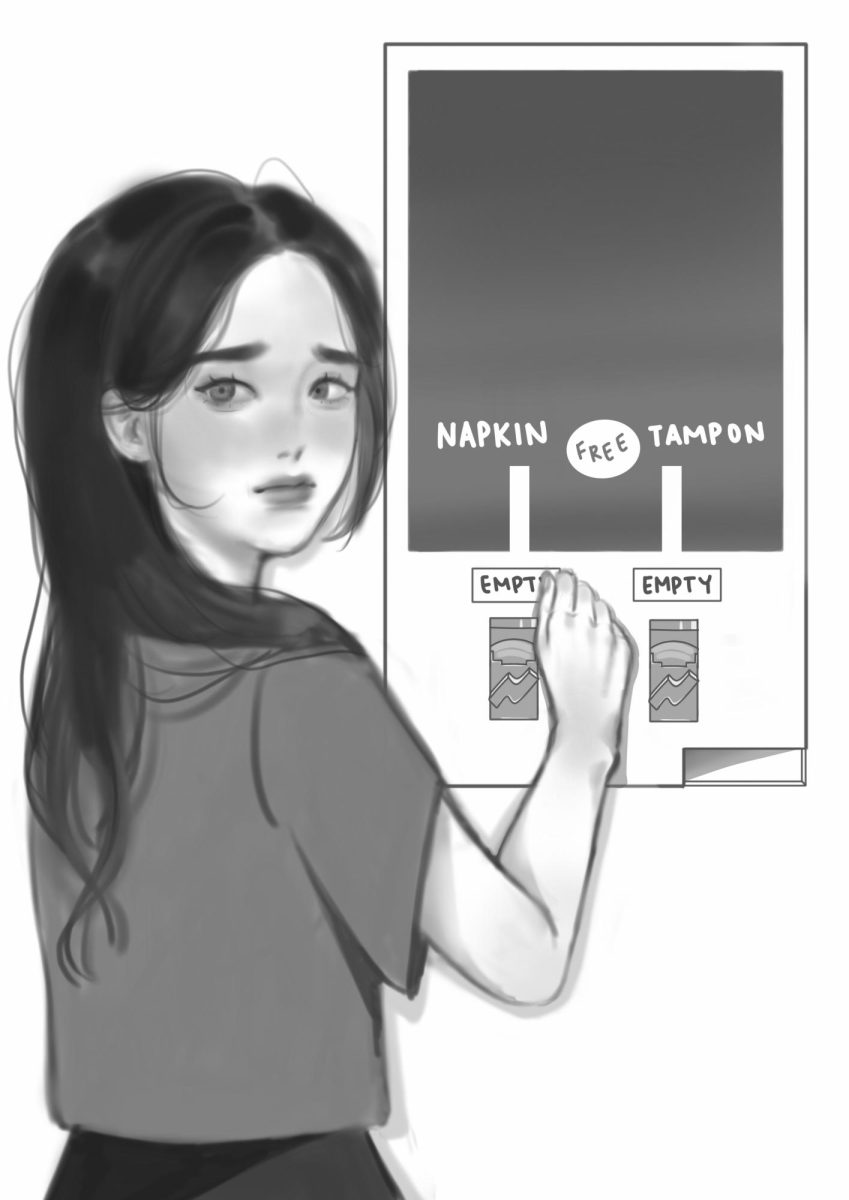


There’s been a lot of discourse surrounding the ethics of AI-generated “art” lately. Points are brought up concerning accessibility, the environment, and what it means for something to be human. The problems with AI art, to me, far outweigh the upsides. The use of AI to make art promotes environmental destruction, negates the work of real artists, and can spread misinformation. On top of all that, it’s not even art.
To understand why AI art is so harmful, you first need to understand how it works. When an AI model generates an image, it usually undergoes one of two different processes. Diffusion is the most common method of image generation, used by DALL-E, Stable Diffusion, and Google’s Imagen, among many others. Diffusion works by starting with a collection of static, then predicting a clearer and clearer image until the image is recognizable. An AI image generator could also use a generative adversarial network (GAN), where a generator keeps making an image until a detector fails to recognize it as generated. Companies like NVIDIA and Artbreeder use this model. Diffusion models are generally cheaper and more effective, but GANs are faster at generating and can be better with specific tasks. No matter how it’s made, in my opinion, this process isn’t art.
Art is a manifestation of a person’s inner thoughts and emotions. A bot can replicate expressions of these things, but it will never experience them. If a bot makes an image to respond to the prompt, it’s not putting any thought into the piece beyond its programming; there’s no motivation behind it other than to carry out a code. When you type in a prompt, the resulting image doesn’t come from a person’s experiences and creative process. AI-generated art is simply a summary of art, put together from real humans’ art into what looks like a drawing or photograph.
Plenty of people use AI as just another medium, and keep customizing and customizing until they make something that does, one could argue, reflect them as a person. Yet even in this situation, the AI is still making decisions for the user, no matter how precise the instructions. If you ask 100 people to take a photo of something, they’ll all do it differently, and those differences will be reflecting them as a person. If you ask an AI to do the same, it will summarize those images and make something that reflects the code that it’s built from. Because of this, the final piece isn’t your thoughts or creative process, it’s still the AI’s. So, still not art.
However, if you still choose to generate AI art, it’s still important to consider other’s opinions on it when selling or sharing it, and be transparent about your tools and methods. Often, people don’t want a piece that’s been AI generated. When asked about what qualities made an art piece good, people talked about aesthetics, but just as frequently they talked about the effort and thought that went into a piece. Yuri Cortazar (‘28) says, “it does change things for me, knowing that it’s made by AI, just mainly because I think it won’t incorporate the same amount of soul or thought process that a normal human would go through.” Even if an AI-generated piece could be just as aesthetically pleasing, its value would decrease to some people simply by knowing it’s AI-generated. This is why, when commissioning AI-generated art, it’s only right that people know what they’re signing up for. Otherwise, a person expecting to get a form of expression will feel cheated if they find out it’s not.
Similarly, human artists will feel cheated when someone puts their money or their appreciation into an AI-generated work as opposed to a human-made one. Especially since the AI models used to make the piece train their models on real artists without their permission. Nearly all leading figures in AI image generation, figures such as OpenAI, Stability AI, and Midjourney, use thousands of artists’ work to train their models, all without artists’ consent or knowledge. This has led to artists suing several major companies for copyright infringement in cases such as Bartz v. Anthropic and Kadrey v. Meta. Both of these cases concluded that the AI didn’t violate copyright as it makes “significant changes” to the artwork; however, many still find it unfair as it steals the artist’s unique style.
But what about uses other than art pieces you’d hang up on your wall? What if someone just wants a quick visual for a presentation, or wants to recreate a scene they saw in a dream for their friends? In these situations, people don’t want “art,” they just want visuals. And yes, AI is able to generate aesthetically pleasing visuals. However, using AI for any form of image generation still contributes to other kinds of harm.
Because of support for AI image generation, it’s improving, and fast. Currently, people are only able to tell when an image is AI-generated about 60% of the time. That’s barely better than a coin toss. While this improvement can make it easier for you to make your presentation decals, it also makes it easier for others to spread lies. Going back to the importance of transparency in AI art: How could this transparency be enforced if you have no way of knowing what’s AI-generated or not? How can you be sure any information you find online is true if most of that information comes in the form of easily fakeable photos and videos? Making AI art better also means making it easier to spread mis- and disinformation that could end up swaying thousands of people to unknowingly support deceitful or harmful causes.
In addition to spreading misinformation, AI data centers, which are used to train AI models, have a detrimental impact on the environment. You’ve probably heard that AI uses up a lot of water, but you may not know the full extent. Cooling just one large data center can use up to 5 million gallons of water per day. That’s more water than the average American would use in 160 years. This water is drawn from reserves that would otherwise be used for fresh drinking water. To make matters worse, the data centers are often built in areas that already have a high demand for fresh water, worsening problems for already disadvantaged populations. Additionally these data centers usually rely on the burning of fossil fuels to run, meaning they have a large carbon footprint.
Whether you think AI is art or not, it causes harm to artists, the public, and the environment. Still, AI is here to stay. So, what can you do to minimize harm? For now, avoiding AI whenever possible is a small but meaningful way to avoid contributing to these issues. The best thing you can do is encourage these AI companies to develop more sustainable, ethical methods of training, and discourage expansion until it can be done without harm. Since AI really is here to stay, we should make sure it helps, not hurts.