


























![[ERROR]: Lack of Women in the Software Industry](https://theechohsmse.com/wp-content/uploads/2024/12/APC_0280-984x1200.jpeg)





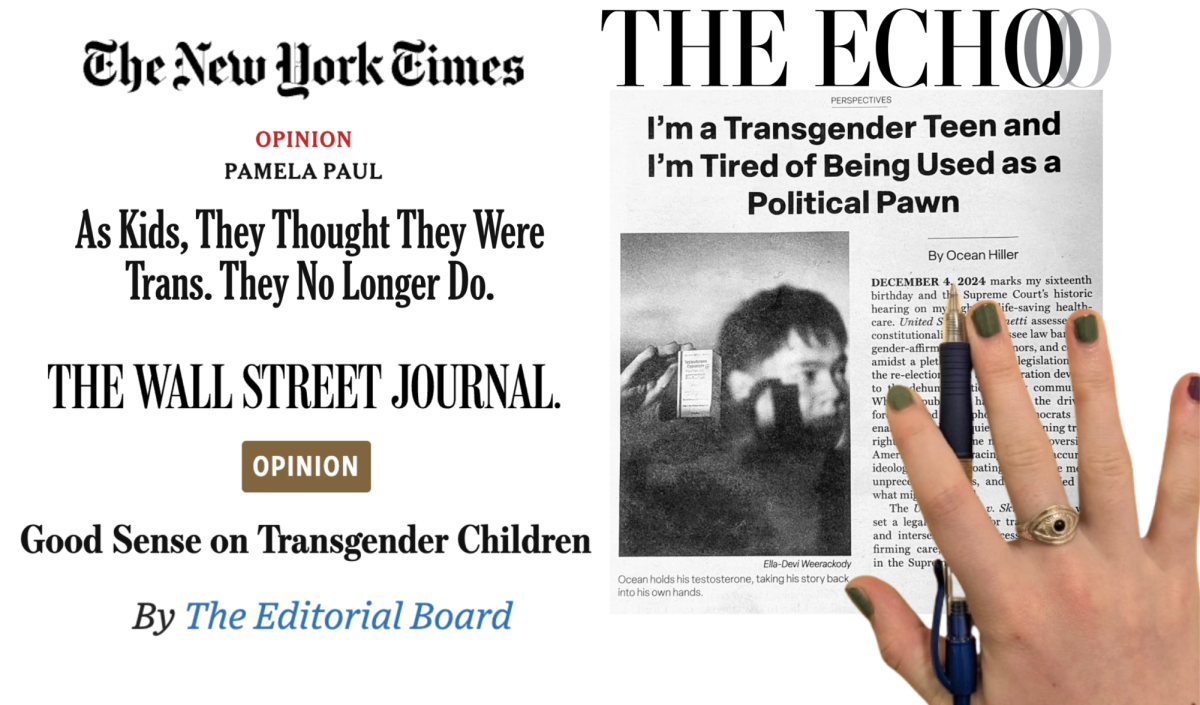
When Trump fueled his re-election with $215 million in anti-trans advertisements, journalism was my way forward. I wrote “I’m a Transgender Teen and I’m Tired of Being Used as a Political Pawn” for Issue 9 of The Echo to reclaim my personhood from myths plaguing public discourse—and other news outlets.
Now, ten issues and two awards later, I seek not to justify my rights as a trans man, but to reveal how the media contorted them into a debate in the first place. Controlling bodies begins with controlling narratives.
The lede of my opinion piece addressed how hearings for U.S. v. Skrmetti, a Supreme Court case on trans youth’s healthcare, coincided with my 16th birthday. Last June, in that same case, the court deemed it constitutional to ban the care that saved my life, citing The New York Times 29 times in amicus briefs. Are you surprised by that statistic? I’m not. Mainstream publications like the Times have consistently failed to cover trans people with accuracy, nuance, and empathy.
The Times’s opinion section has platformed bigots instead of trans journalists to dissect our own stories for us. Former columnist Pamela Paul, for instance, repeatedly questioned the validity of gender-affirming care, overlooking major medical organizations’ support for it and sourcing biased research. In one article titled “As Kids, They Thought They Were Trans. They No Longer Do.” Paul cherry-picks the experiences of a few detransitioners (who make up just 1–4% of those who transition) to attack all trans minors’ access to care.
Erroneous sourcing bleeds into traditional reporting, too. A 2023–24 investigation by Media Matters and GLAAD found that 66% of news articles by the Times about anti-trans legislation failed to quote any trans people, while 18% quoted anti-trans misinformation without contesting it.
Even articles that do quote trans people alongside those who doubt our existence set a dangerous precedent of false balance. Framing two perspectives as equally legitimate when one is rooted in people’s lived experiences and the other in pseudoscience warps readers’ understandings of reality. And when trans people make up an estimated 1% of Americans, many cisgender people likely rely on the news to learn about us.
Just this February, the Times mischaracterized an American Medical Association (AMA) statement on gender-affirming care. This statement reaffirmed the organization’s support for evidence-based treatment for trans minors and adults alike; however, the Times claimed the AMA newly “backed limitations on gender-related surgical treatments for minors.” When the AMA requested a correction to the story, the Times denied it, according to Assigned Media.
The Society of Professional Journalists’ Code of Ethics outlines four core responsibilities that journalists must uphold: “Seek Truth and Report It,” “Minimize Harm,” “Act Independently,” and “Be Accountable and Transparent.” Across both commentary and hard news, the Times has betrayed these principles when reporting on my community.
However, we have fought back: In 2023, over 180 Times contributors and 120 organizations signed a letter accusing the newspaper of biased coverage and demanding that it consult more with trans people as sources, writers, and editors.
The letter references the Times’s history of printing anti-LGBTQ+ rhetoric: “In 1963 … ‘Growth of Overt Homosexuality in City Provokes Wide Concern’ stated that homosexuals saw their own sexuality as ‘an inborn, incurable disease’—one that scientists, the Times announced, now thought could be ‘cured.’” This echoes today’s anti-trans fearmongering about gender dysphoria being a “social contagion.”
Furthermore, the Times “neglected to put AIDS on the front page until 1983, by which time the virus had already killed 500 New Yorkers.” A. M. Rosenthal, the newspaper’s executive editor from 1977 to 1986, exploited his position to withhold promotions from colleagues suspected of being gay; he also oversaw the publication of an op-ed arguing for the tattooing of all people with AIDS. Rosenthal’s paper of record obscured the horrors of the epidemic, exacerbating stigma and thus enabling death.
The LGBTQ+ community is far from the only one that mainstream journalism has further marginalized. 18th-century American newspapers ran ads facilitating the enslavement of up to 3,400 Black and Indigenous people so that white editors could pad their pockets. During the Jim Crow era, investigative journalist Ida B. Wells documented horrific lynchings in the South—only for the Times to respond by calling her a “slanderous and nasty-minded M*latress [derogatory racial slur].”
A 2019 Times editorial condemns this attack, saying that at the time, “The Times was not owned by the family that controls it today.” However, it still begs the question—can the newspaper’s ethos really be reinvented?
I chose to spotlight the Times because it appears a bastion of credibility to many American liberals, and as a journalist, I believe in holding power to account. However, know that plenty of other publications have perpetuated bigotry under the guise of fact.
For instance, The Wall Street Journal’s editorial board endorsed the American Society of Plastic Surgeons’s dissuasion from youth gender-affirming care as “Good Sense on Transgender Children”—without quoting any transgender children. Right after the Supreme Court’s anti-trans Skrmetti decision, The Atlantic published a piece titled “The Liberal Misinformation Bubble About Youth Gender Medicine.” Et cetera.
In their 1988 book, Manufacturing Consent: The Political Economy of the Mass Media, Edward S. Herman and Noam Chomsky argue that corporatization has caused media outlets to prioritize elite interests over responsibly informing the public. Their ideas remain potent now as journalism becomes increasingly digitized: Market pressures lead news companies to publish sensationalized stories that will get the most clicks, not ones that are deeply reported and meaningful.
And what headlines could be more alluring than those about misguided 12-year-olds undergoing “irreversible operations” to the horror of their loved ones?
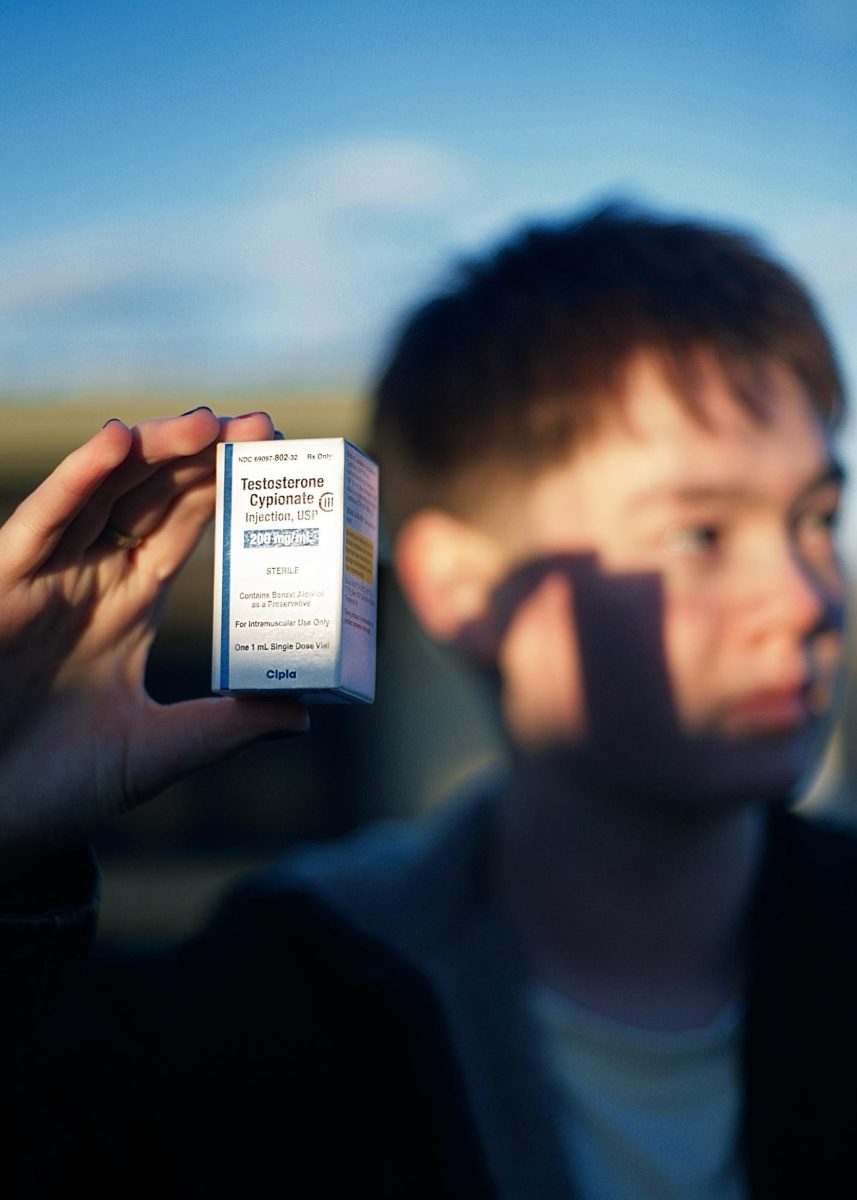
(Please, please, that’s not what’s happening.) Getting gender-affirming care as a minor requires maneuvering through countless hoops just for a baseline feeling of belonging in the world—in my experience, at least—and it rarely entails surgery.
Thanks to reckless editorial choices that delegitimize the truth and embolden politicians to wage culture wars, it’s become even harder to access. Recently, I read the Times article “Manhattan Hospital Ends Medical Treatment for Transgender Youth.” I was maddened equally by the hospital’s negligence (which is illegal under New York State law) and by the newspaper’s objective, complicity-evading tone.
There are always more headlines: “Transgender Kansans Sue After Driver’s Licenses Canceled.” “Trump Administration Opens the Door for ICE to Target Anyone Suspected of Being Trans.” “Experts Warn U.S. in Early Stages of Genocide Against Trans Americans.” Newly minted atrocities gleam at me so frequently that they could appear ephemeral—but as both a victim and a producer, I cannot escape the news.
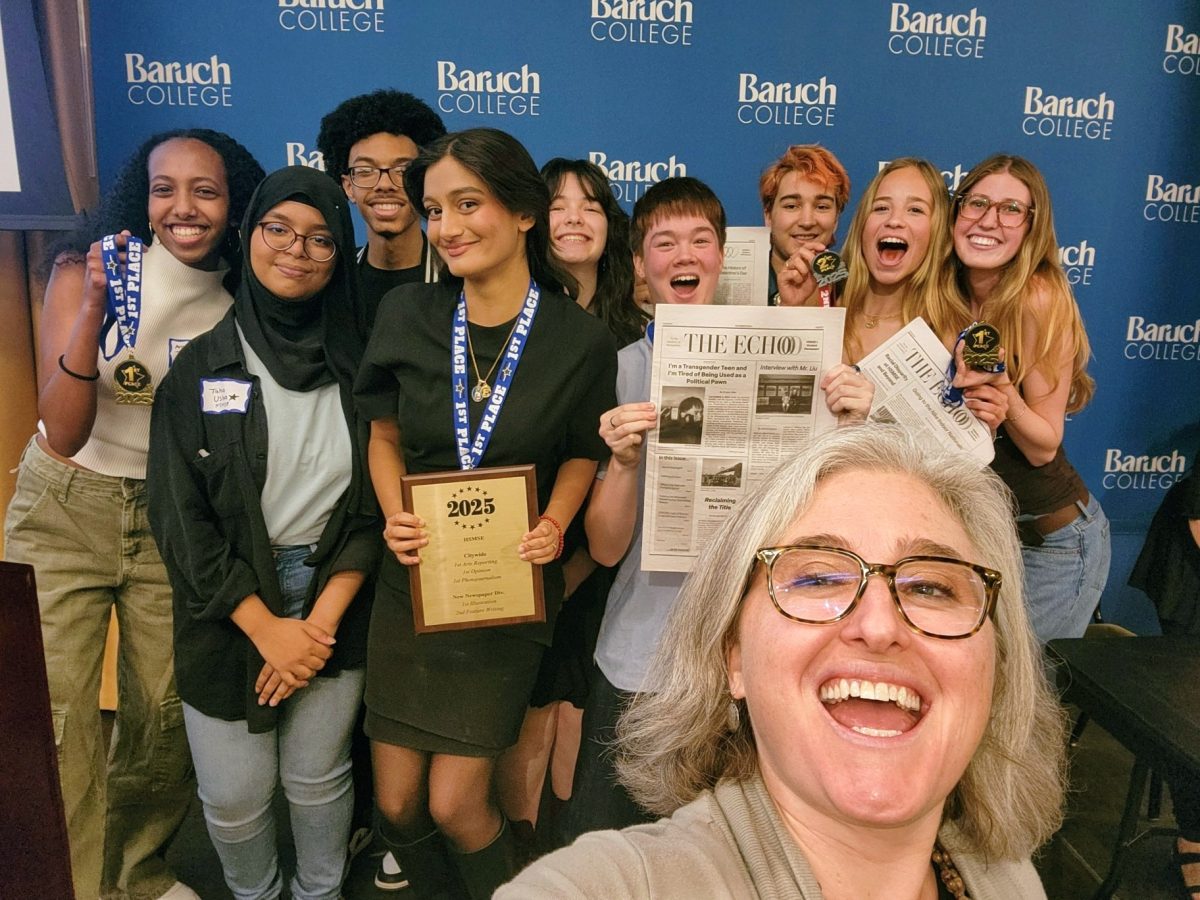
The journey of publishing “I’m a Transgender Teen and I’m Tired of Being Used as a Political Pawn” in late 2024 cemented my love for journalism; I was honored to win two opinion writing awards from Baruch College and Youth Journalism International for it. Yet the more I reflect on the op-ed, the more I realize it was an implicit reaction to the failures of dominant reportage.
As the pages yellow and adulthood approaches, I’m eager for my rights to become a slightly smaller subject of debate. I’m also wondering how to begin establishing myself in an industry whose most idolized publications have betrayed the values that inspired me to pursue it.
And, given the escalating persecution of trans people, was it safe to have chosen such a vulnerable topic for my magnum opus of high school?
I’m not sure. Speaking out feels all the more precarious just 16 months later.
But the support of The Echo’s readership—from my classmates’ initial congratulations in HSMSE’s halls to the eloquent praise of judges at awards ceremonies—has reminded me that hostile policies cannot revoke the meaning contained in my words. My identities as a journalist and as a trans man will always be linked in my quests for truth, change, and clarity in expression; neither can be taken away from me.