


















![[ERROR]: Lack of Women in the Software Industry](https://theechohsmse.com/wp-content/uploads/2024/12/APC_0280-984x1200.jpeg)



As many of us learn in biology, humans each have their own set of genetic material that makes them unique. This DNA is in all of our cells and, similar to our fingerprints, identifies us all as unique individuals. But to what extent does this information reach the general public, and how much personal data is open for anyone to access?
The internet has allowed humans to spread information faster than ever before. We can communicate, connect, and message each other from across the world. Now, more than ever, our personal information is easily accessible. During Regents week, I toured Vassar College. A few weeks prior, my grandmother informed me that her grandmother had been a student there and later a professor, one of the first female professors at the school. The only information we had about her was an obituary in a local newspaper, which my grandmother had a picture of in her phone. During the drive to Poughkeepsie I did some Googling, and the amount of available information about her was incredible. I found a full pdf of the newspaper with her obituary, her name in lists of Vassar donors, and most notably a link to Ancestry.com, which had information about her son, including his date of birth and death, his name in multiple censuses, and photos associated with him (though they may not have been accurately paired with his name). More information was behind a paywall, and though it wasn’t available to me or the rest of the public, it would not be difficult to access for anyone looking to solve a crime or looking to simply connect me to my family.
What is genetic genealogy?
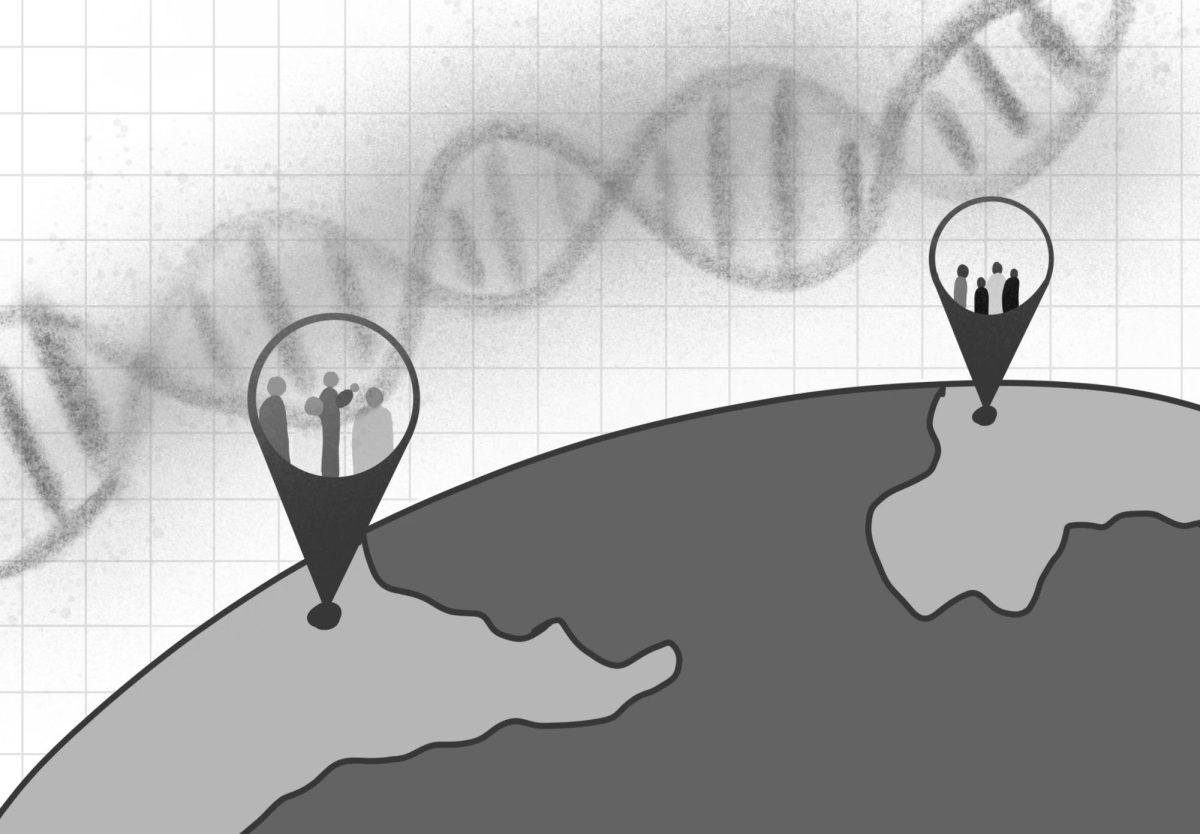
Genetic genealogy is the use of DNA testing to find relationships between people. It does this by relying on DNA testing, often with companies such as 23andMe or Ancestry. Sometimes genetic genealogists use websites and public databases like GEDMatch, which allow anyone to upload the results of a DNA test to find DNA matches. It works by finding matches to people who share a certain percentage of the same DNA as the sample entered into the system, so it could potentially connect someone to an immediate family member that has put their information in, but may also connect a sample to thousands of third cousins if only a very small amount of the DNA sample matches those in the system already. Genetic genealogy has proven to be a huge breakthrough in solving crimes, and it could be as revolutionary as the introduction of finger printing. Even if the person who committed the crime hasn’t submitted their own DNA, if a distant relative has, the person can be tracked down.
“With Great Power Comes Great Responsibility”
Genetic genealogy can have great applications, but that comes at a cost, for example in the case of the Golden State Killer. The Golden State Killer was a serial killer most active in the 1970s and 1980s. He terrorized neighborhoods across California by burglarizing homes and killing residents. According to authorities, he went undetected for years because of poor communication between different investigative departments. Many investigative agencies were searching for the same man but did not know it because of various nicknames and aliases.
Finding his true identity was in large part due to amateur investigator Michelle McNamara. At night, she would scour the internet and any other available sources for information that officials and previous investigators may have missed. She died unexpectedly in 2016 but left behind thousands of files related to the case. Unfortunately, this still wasn’t enough to identify the Golden State Killer, so modern investigators turned to genetic genealogy. Using DNA from a Golden State Killer double murder in 1980, retired investigator Paul Holes, with the help of the FBI and amateur genealogist Barbara Rae-Venter, matched the sample to a great-great-grandparent of the unknown murderer on GEDMatch, the website mentioned above with a public DNA database. Now they were given a small sample of cousins as possible murder suspects, so investigators spent months recreating the family tree until they landed on now-80-year-old Joseph James DeAngelo, the Golden State Killer. This is how genetic genealogy led to his arrest in 2018.
This also means that to find him, authorities looked through the biological identities of thousands of people. His arrest sparked further investigation into the field and its usage in forensics. Even during the criminal trial of the Golden State Killer, the FBI was reluctant to share their process for identifying the killer, worried about public backlash or new restrictions limiting their access to this technology.
Genetic genealogy works well because it relies on similar DNA, not identical matches, which is how very distant family members such as great great grandparents and second or third cousins can be connected to samples entered into the system. This is important for criminal investigators, but could be a dangerous tool when misused. The LA Times writes that “Some legal and privacy experts are concerned that the race to use genealogical databases will have serious consequences, including eroding privacy protections and broadening police power.” On the other hand, many people argue in favor of submitting DNA and as much information as possible knowing it could help solve crimes in the future. In all scenarios, genetic genealogy requires the public to trust the government and investigators to use information properly.
What Does This Mean Today?
In our ever-evolving world, we have become more interested in our ancestors and our past. But our current generation must understand that generations who are yet to exist will be impacted. Sharing genetic information is a tradeoff that has recently sparked a lot of conversation concerning justice versus privacy and safety. Modern uses of DNA have helped law enforcement identify criminals, helped people identify their biological parents, and helped families connect with each other and their pasts. It was even used in identifying suspects for the recent Louvre robbery. However, it also jeopardizes the safety of many people because DNA is personal and gives the public access to private information. This could be used for identity theft or other criminal activity. Another issue with genetic genealogy is its large gaps in information, particularly with race. Barbara Rae-Venter said in an interview with CNN that “the databases are about 80% white,” meaning that depending on the suspect’s ancestry, they could be much more difficult to match. Genetic data has also been used to support racist ideologies on the internet, including claims about children’s IQs being tied to their race. According to The New York Times, families that agreed to partake in the fringe study said they “never would have agreed to participate had they known it could be used to promote racial division.” The field is young and will likely lead to both more benefits and more drawbacks as conversations around genetic genealogy continue, particularly in the field of forensics. From where we are now we cannot tell whether it will take us to the ultimate criminal identifier or lead to the downfall of civilization, but what is important is staying informed. Anyone taking DNA tests and anyone using genetic genealogy to investigate have the responsibility to understand the risk they are taking.
Final Notes
I was inspired to write this article after listening to the Bear Brook podcast, a true crime podcast about a cold case from the 1980s that resurfaced in the 2010s about bodies found in Bear Brook state park in New Hampshire. The podcast details the timeline of the murders, and discusses the use of genetic genealogy in this case as well as future cases.
Though I wasn’t able to include that story here, I highly recommend listening if you’re interested in genetic genealogy and its various applications, or if you really love a mystery.
This is an extremely broad subject with lots of information, so if you are interested in more information here are some other materials and resources:
- I’ll Be Gone in the Dark: One Woman’s Obsessive Search for the Golden State Killer by Michelle McNamara
- I Know Who You Are: How an Amateur DNA Sleuth Unmasked the Golden State Killer and Changed Crime Fighting Forever by Barbara Rae-Venter
- The Immortal Life of Henrietta Lacks by Rebecca Skloot
- “Genetic Data From Over 20,000 U.S. Children Misused for ‘Race Science’” by Mike McIntire, The New York Times
- “The untold story of how the Golden State Killer was found: A covert operation and private DNA” by Paige St. John, LA Times