


















![[ERROR]: Lack of Women in the Software Industry](https://theechohsmse.com/wp-content/uploads/2024/12/APC_0280-984x1200.jpeg)






Note: The Echo typically does not quote anonymous sources, but this article makes exceptions due to the sensitivity of these events and to ensure student participants felt safe sharing their experiences.
The deportation of undocumented immigrants has been one of the central pillars of Donald Trump’s 2024 election campaign and his second term as President. Immigration laws are enforced by U.S. Immigration and Customs Enforcement (ICE), whose conduct has been protested for the past ten years. Its recent deployment in Minnesota is sparking intense uproar, especially among students.
On December 4, 2025, the DHS announced Operation Metro Surge: an extensive deportation crackdown in Minnesota’s Twin Cities (St. Paul and Minneapolis) and one of many mass deportation campaigns in large American cities. Minnesota is a sanctuary city; it’s welcomed 81,000 immigrants between 2020 and 2024, including the largest Somali community outside of Somalia, in part due to its comprehensive social safety net (government-led programs to reduce poverty). A massive case of fraud in the 2020s exploited these government programs for meals, therapy, and housing, amounting to the theft of nearly 1 billion taxpayer dollars. The majority of those involved in the fraud were Somali immigrants, leading President Trump to repeatedly reprimand Somali communities in late 2025, calling them “garbage” in a cabinet meeting, repeatedly accusing them of having “low IQ,” and claiming that they are “completely taking over the once great state of Minnesota.” Some have speculated that President Trump’s fixation on Minnesota may also be related to its left-leaning policies on abortion and gender-affirming healthcare, as well as its extraordinarily high rates of civic participation. And so, over the course of two months, nearly 3,000 ICE and Border Patrol agents were deployed in Minnesota.
Federal agents have been attacking Minnesota residents (both U.S. citizens and non-U.S. citizens) throughout December and January: tackling residents, dragging people out of their vehicles, interrogating locals, breaking windows, and using (what some describe as excessive) force on individuals who did not pose any immediate threat. ICE’s national detention standards state that officers “shall use only the degree of force necessary to gain control of detainees,” a limit that was clarified in a 2023 DHS memo: officers “may use deadly force only when necessary” and when they have “reasonable belief that the subject of such force poses an imminent threat of death or serious bodily injury.”
Under President Trump, Border Patrol (a branch of U.S. Customs and Border Protection, usually stationed at U.S. borders) is being deployed inland to help ICE deport undocumented immigrants. Border Patrol Commander Greg Bovino led Operation Metro Surge, but was removed from his leadership position following criticism by the public and the Trump Administration regarding Alex Pretti’s killing.
Nearly 40,000 people were arrested by ICE in January alone—4,000 of whom were apprehended during Operation Metro Surge—and an additional 180,000 individuals and families are being monitored as of February 7. 73.6% of those in custody have no criminal convictions, a notable discrepancy from the Trump administration’s claims to focus on the deportation of criminals. Conditions in detention centers, including the behavior of federal agents, have led to six deaths: Luis Gustavo Núñez Cáceres died from a heart condition, Geraldo Lunas Campos was choked to death while waiting in line for medication (according to the DHS, he died by suicide), Parady La died receiving withdrawal treatment, Luis Beltrán Yáñez-Cruz died due to a heat condition, and the deaths of Víctor Manuel Díaz and Heber Sánchez Domínguez are still under investigation.
On January 7, Renee Nicole Good, a U.S. citizen and mother of three, was fatally shot in the head, forearm, and chest. Video footage from ICE agent Jonathan Ross shows Good in her parked Honda SUV, speaking with agents (including one officer who ordered her to step out of her vehicle). As she began to drive off, the footage shows Officer Ross saying “whoa” and firing his gun, killing Good.
Around two weeks later, federal agents wrestled Alex Pretti to the ground and repeatedly struck him with a pepper spray canister. Pretti, an ICU nurse, had put himself between two civilians and a group of ICE and Border Patrol agents while holding his phone and keeping his registered gun at his waistband. After disarming the motionless Pretti, agents shot him 10 times, killing him. The deaths of both Renee Good and Alex Pretti sparked thousands of demonstrations across the nation, calling for the reform or even eradication of ICE.
Thousands of students have joined by organizing walkouts, disrupting their school day to raise national awareness about ICE’s actions. Students across the country distributed pamphlets, distributed “know your rights” materials to their peers, followed ICE sightings on social media (akin to whistleblowers in the Twin Cities), and posted announcements on social media.
Despite being frequently criticized as a platform for activism and political education, social media has been an incredibly powerful tool for spreading calls to walk out. HSMSE students posted two different walkout calls on Instagram: The first was, as some students reported, treated humorously by its creators, whereas the second was planned more thoroughly through social media and word of mouth. Organizers planned a takeover of Baskerville Hall’s loudspeaker during second period and prepared to join other schools at Union Square. Organizers also reached out to larger organizations, such as Dare to Struggle, which posted MSE’s flyer on their Instagram story. A similar combination of oral and social media was also used at the Museum School, one student reported. There, students left the school in separate groups during passing periods and met outside of their building before marching to Union Square. Students across the country were also advised by a walkout guide created by organizers of the National Shutdown, which recommended various methods of outreach, preparation, and walking out itself.
The epicenter of many walkouts was January 30, a date that the University of Minnesota Student Unions had deemed a National Shutdown. The message of over 1,000 organizations (“no school, no work, no shopping”) rippled through the country, from Maine to Georgia, California to NYC. Dozens of students walked out of Lewiston High School, Maine, to Kennedy Park—a route along which many Lewiston police officers stood. Students walking out in Maryland blocked highway traffic, weaving through stopped cars while holding signs up high. Chants boomed through the parking lot of Centennial High School, Georgia, one of the 100 Georgia schools that walked out on Friday. In Oakland, California, students from dozens of high schools marched to Fruitvale Plaza, “the heart of Oakland’s immigrant community.” A poster in Washington state read, “We are skipping our lesson to teach you one.” One of the largest high schools in the country (and a fellow New York specialized high school), Brooklyn Tech, saw over 500 students walk out on Friday to Fort Greene Park and march to the Barclays Center and back.
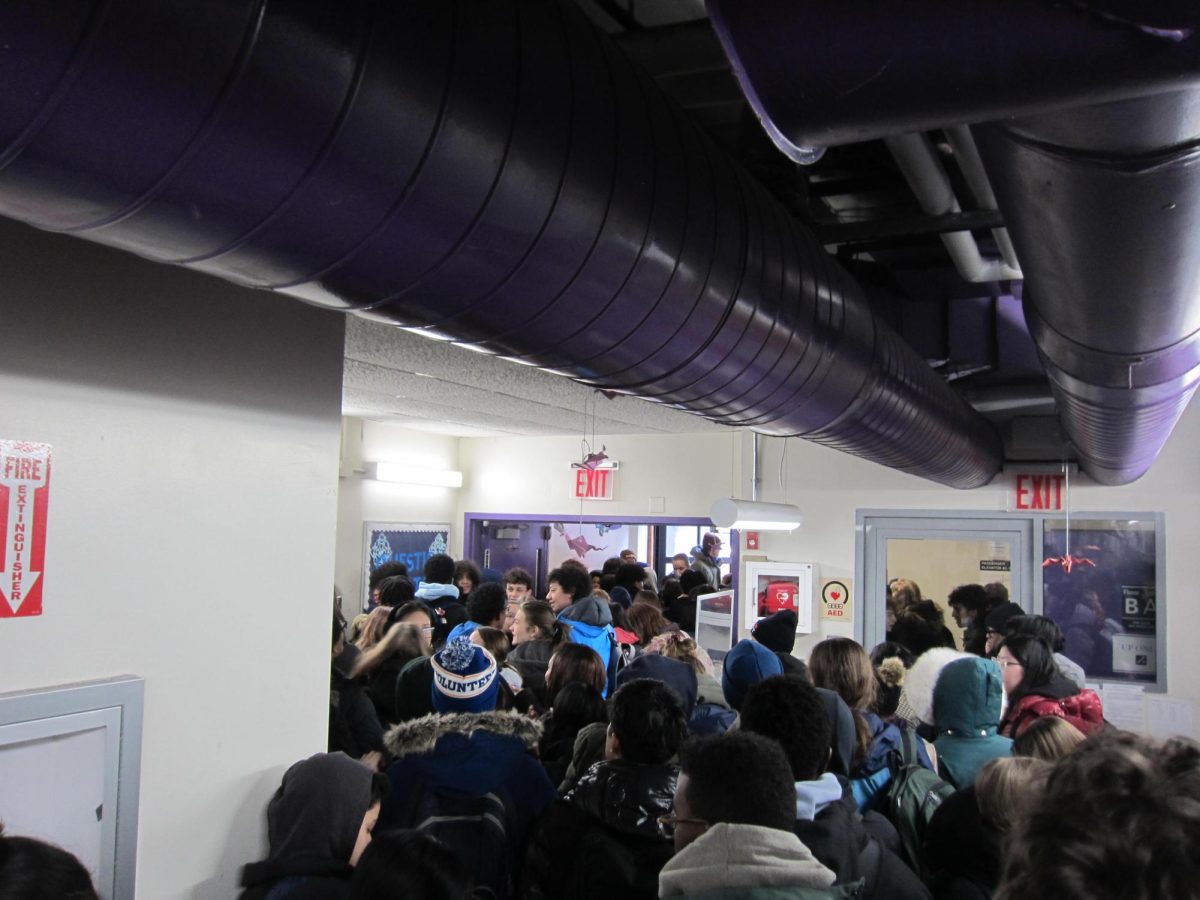
Just a borough away, approximately 200 HSMSE students, according to Principal Dolcy, walked out of class. In Baskerville Hall, they waited in the B-floor hallway for around half an hour before being told they would be released upon signing out (for a more detailed timeline, go to theechohsmse.com or scan the QR code below). As students left, Principal Dolcy and other staff reminded them that, since it was not a school-sanctioned protest, leaving the building would be considered skipping school. Thus, some students wrote down fake contact information or purposefully made their handwriting illegible. Any disciplinary action at HSMSE remains private.
After gathering outside the school entrance, students slowly walked to the 145th St. train station and took the C train down to Washington Square Park. Soon after, they began marching to Union Square, joining other schools in freezing temperatures. Police blocked traffic when MSE students marched from Washington Square Park to Union Square and stood near the protestors, who’d gathered in a snowy part of the square. Attendees gave and listened to speeches over megaphones, held signs high in the frigid air, and chanted. “People were really angry, which was good,” one organizer noted. “There was a lot of camaraderie, and people were excited that they didn’t feel alone and that it felt like we could do something.” Nearby pedestrians recorded the protestors, some cheering them on and joining.
With so many students protesting across the country, motivations for walking out varied. It’s optimistic to assume that all students who walked out had strong convictions to protest ICE. Some were rumored to have walked out and walked home, others may have simply been swept along with the waves of students leaving classrooms, and even more felt unable to. Some students, out of concern for their own and their families’ immigration status, may not have felt comfortable walking out and protesting. Moreover, “Research shows that even just having another peer around can change … the risk-taking tendencies of teenagers,” according to Dr. Emily Falk. Seeing their classmates sit still as walkouts ensued may have stifled the urge to walk out in some out of fear of the social (or legal) repercussions, while others may not have wanted to be left behind in the flurry of students leaving. At HSMSE, one student in the gym observed a group of boys “cornering people as they entered the locker room … asking, ‘Oh, are you going to walk out?’ If people said no, they would call them ‘pro-ICE’ or ‘Trumpies,’ and that made me really uncomfortable and not want to join them.” The student added that peer pressure “is never a safe way to go about [activism].”
Responses from school administrations across the country varied: Some were in support of students protesting, some weren’t, some threatened disciplinary action in various forms, and others stayed entirely neutral. The walkout guide published by National Shutdown organizers encourages students to meet with their school’s administration, proclaiming, “If your administration refuses to sanction the walkout, don’t let that stop you.” David Law, the superintendent of Minnetonka Public Schools (a few miles outside of Minneapolis) and president of The School Superintendents Association, added that “Schools do not coordinate walkouts, but they should be responsible in ensuring there’s no disruption to the educational setting of other students who are not participating in walkouts.”
In Texas, hundreds of students have walked out despite threats from Governor Greg Abbott to strip funding from school districts and arrest “disorderly” student protestors. Thomas Baughman, for example, explained to The New York Times how he and fellow students planned a walkout at his school in Dallas in the face of administrative criticism. Walkouts also continued in the Houston area, despite repeated warnings from school officials. Fellow student journalist Mallika Mohan at Houston’s Bellaire High School recalled how her principal, Michael Niggli, “got on the speaker with the same message about the potential for disciplinary action.” Republic lawmakers in Oklahoma have echoed Gov. Abbott’s concerns and noted that walkouts target “federal agents who are carrying out their lawful duties.” Gov. Kevin Stitt claimed that 122 students had been suspended for walking out on February 5, and urged students on X to make their voices “heard responsibly.” At HSMSE, one staff member told students waiting in the B-floor hallway to “Use your head, I know you have one.” One organizer had emailed Dean Zara, who “was supportive of the [walkout],” but he, as other administrators, did not know about organizers’ plans to project their message through the loudspeaker. “A lot of the teachers and other faculty who were in the hallway … were, like, encouraging and cheering us on,” one organizer said. Another student saw a staff member “putting up her phone and filming.”
Student walkouts continued throughout early February, such as in Virginia, Illinois, and Texas. On February 12, the Trump administration said that ICE’s heightened presence in Minnesota would withdraw, leaving skepticism and a “cautiously optimistic” Gov. Tim Walz. Student protests in all their forms have led to immense change—reforming school finance systems, advancing civil rights, and even cementing students’ fundamental right to free speech—and will certainly continue to do so. This isn’t an easy thing that we’re trying to do,” one organizer commented. “There’s going to be a lot of opposition even on these small, schoolwide levels. It’s hard to organize and to break the rules sometimes to accomplish something bigger.”