
























![[ERROR]: Lack of Women in the Software Industry](https://theechohsmse.com/wp-content/uploads/2024/12/APC_0280-984x1200.jpeg)







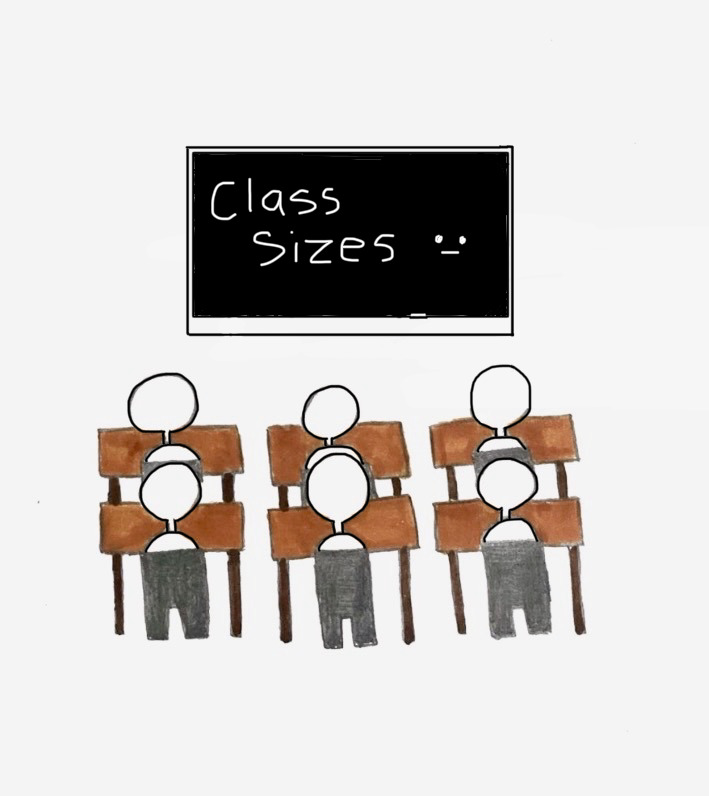
When you walked into some of your classes for the first time this school year, did you notice a change in the amount of students per class?
In large classes, when you raise your hand, it’s often drowned out by the crowd of other students. Maybe you even struggle to see the board because of all the heads blocking your way, which takes away from the precious notes you were scribbling down. These are just a few examples of larger class sizes inhibiting students’ learning.
However, if you haven’t noticed, there’s been a change this year. The average class size has shrunk by a noticeable amount. The board is easier to see and you’re able to take down those notes you’ve been vying for. Your hand is no longer drowned out in a sea of students. To facilitate this change, new teachers are entering the school and joining our community. Now, you’re probably wondering, what caused these changes?
A bill was signed into law in 2022 by Governor Kathy Hochul to limit NYC public school class sizes; for high schools, it mandates a maximum of 25 students per class. This bill was protested by Mayor Eric Adams; however, many educators and parents provided support for it, arguing that research shows that smaller class sizes boost test scores and lead to higher attendance. This, in turn, produces greater classroom engagement. As more and more schools started to comply with this new bill, it led to noticeable changes for students and teachers alike.
When we interviewed a few teachers at HSMSE, they tended to share the same thoughts. Ms. Walker agreed, saying, “Students are less afraid to air their perspectives in class discussion. I’m getting to know them better, and they get to know me better.” Mr. Liu says, “In terms of giving more attention to my students it’s much easier … I’m able to help my students more on a one-on-one basis. [I get to provide a] little more attention and check in with each student more often.” Ms. Hesseltine notes, “I think that students are participating more and are more active when we’re doing a class discussion or an activity because there’s less room to hide. You can’t just kind of wait for those students who most often raise their hands.”
Although costly, smaller class sizes have let students take action in a classroom setting. As former Mayor Adams’ Office stated on November 17, 2025, $450 million was invested into NYC public schools to fund more teaching positions and assistant principal positions across all schools. This allowed for new teachers to join schools and provide support in teaching classes with smaller class sizes now in effect.
While smaller class sizes may be hard to adjust to for some, many are embracing this change. 64% of classes in schools across New York City are currently complying with the bill, amplifying support of the law. Many teachers at HSMSE have noticed more participation in students no longer overwhelmed by an overcrowded classroom (though not 100% of classes have reached full compliance at the time of writing). So, the next time you step into a classroom, take notice of how many people are in your class. Reflect on how this number plays a part in your curiosity, your engagement in class, and your education as a whole. Happy learning, everyone!
If you want more on this topic, check out Chalkbeat’s article with quotes from Ms. Hesseltine. Also, check out The Echo’s original article on class sizes here. HSMSE-specific class size statistics will be explored in an upcoming issue.
Correction: The print version of this article did not clarify how the 64% compliance statistic was obtained. It applies to NYC DOE schools in general, not specifically HSMSE. As of the time of writing, our school’s class sections have not yet reached 100% compliance with the mandated maximum of 25 students.