



























![[ERROR]: Lack of Women in the Software Industry](https://theechohsmse.com/wp-content/uploads/2024/12/APC_0280-984x1200.jpeg)





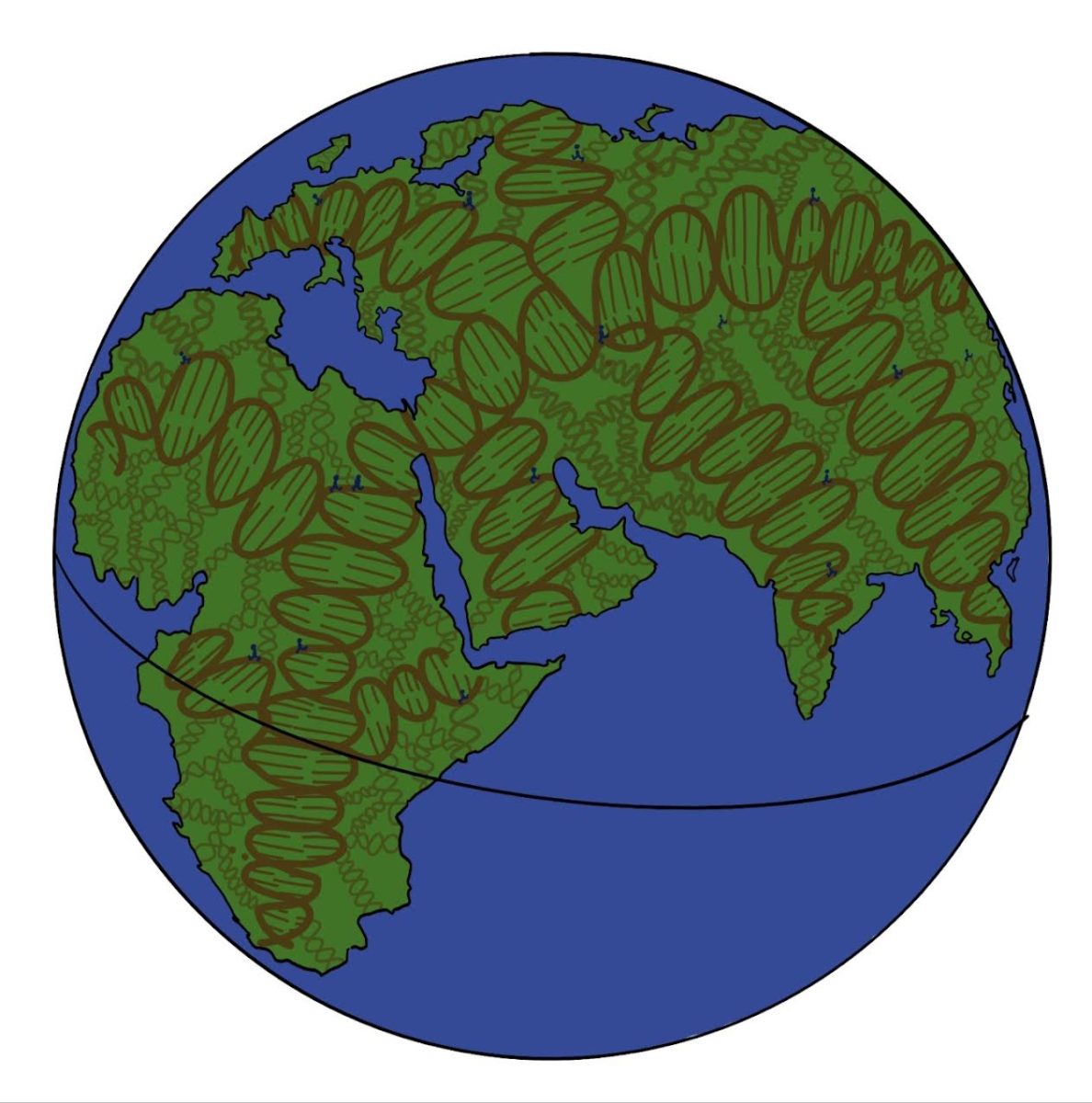
Our understanding of human history has greatly evolved over the past centuries: from pure speculation, to archaeology, linguistics, and now genetics. Studying the genetic variations of humans across time and space reveals human migratory patterns and the spread of mutations that still influence our modern genetics.
In order to reconstruct and observe the genome of ancient remains, geneticists sequence the small segments of surviving DNA. First, DNA is isolated from small pieces of bone and put in a sequencing machine, before being mapped onto an anatomically modern reference genome to identify the specific areas that belong to the ancient human. Researchers then analyze the results, comparing the genome with others to find patterns or differentiations. These differentiations, called “genetic markers,” can be found in one of every thousand letters in the 3-million-letter long human genome. As waves of archaic humans migrated out of Africa around 2 million years ago, genetic markers in the human genome have constantly adjusted and adapted to their environment.
Homo sapiens began differentiating from other archaic humans around 100,000 years ago by making certain cognitive advancements, including adaptable resource extraction, technological innovation, and artistic cognition. In South Africa, various ice ages eventually gave way to a coastal plain rich in food whose exploitation prompted humans to develop a concrete understanding of time, consequences, and group coordination. These advancements fostered the continuous nature of human migration, but could also be explained by a variant of the DRD4 gene that’s characterized by risk-seeking, heightened focus, and problem-solving, fueling the human drive for exploration.
But humans (both archaic and modern) didn’t leave Africa in one massive wave: Research on Helicobacter pylori, a bacteria that has been causing stomach infections for nearly as long as anatomically modern humans have existed, confirms the existence of a second out-of-Africa migration. The European H. pylori population is a mixture of an Asian and a northeast African H. pylori population, meaning that anatomically modern humans must have mixed with northeast Africans around 70,000 years after the first major out-of-Africa migration.
As anatomically modern humans continued to migrate out of Africa, they also interbred with Neanderthals—who had left Africa between 700,000 and 400,000 years ago. Neanderthal DNA granted humans migrating north immunity to previously unfamiliar pathogens and various methods of adapting to the cold. Europeans also evolved to digest lactose because cold winters made milk the only accessible food source from livestock. In addition, various high-altitude populations (such as Tibetans, Ethiopians, and Andeans) evolved convergently, developing variations of hemoglobin that offered distinct genetic solutions for coping with low oxygen. Recognizing these differences helps advance the study of diseases and how different populations may undergo different treatments to deal with them.
But human migration didn’t just end with the out-of-Africa migrations. Genetic studies have revealed many ghost populations—extinct populations that leave genetic traces in living beings—that wandered the world for hundreds, if not thousands, of years.
In 2012, geneticists at Harvard University identified a ghost population called the Yamnaya: a horse-riding group of steppe pastoralists in Northern Eurasia and Siberia. In addition to their genetic contribution to the modern European genome, the Yamnaya contributed to the genetics of Native American ancestors who crossed the Bering land bridge into Alaska. The Yamnaya were also one of the primary vehicles for the spread of Indo-European languages and culture. Understanding ghost populations like the Yamnaya helps us understand the spread and evolution of language, culture, and genetics.
But studying genetics—especially in their relation to human history—has significant social and political impacts that researchers must be aware of. In 2022, a conference of anthropologists, geneticists, archaeologists, and curators came together to determine the ethical guidelines of DNA analysis. They agreed that individual remains being studied must be treated carefully—using as few bone and tooth remains as possible to limit the destruction of what are still human remains. Archaic hominids (especially Neanderthals) interbred with humans so much that it’s pointless to create an ethical boundary of what is “human” and what isn’t. Such boundaries can quickly lead to claims of “biological fitness” and scientific racism (such as those that the Nazis perpetuated).
Studying human genetics isn’t about finding a thin line between species; it’s about discovering how genetics evolve so that we can gain a broader understanding of our origins and find the best solutions to modern-day issues. Our constant search for improvement and discovery has been and always will be the vehicle for human development and advancement. Maybe the story of our DNA isn’t about where we came from, but about why we kept moving.