








































![[ERROR]: Lack of Women in the Software Industry](https://theechohsmse.com/wp-content/uploads/2024/12/APC_0280-984x1200.jpeg)







In 1957, the Soviet Union launched Sputnik 1 into low Earth orbit, initiating the Space Race between the US and the Soviet Union (USSR). Space was the next frontier for humanity, and the two superpowers of the time each wanted to show their dominance over it. For the next four years, the Space Race was about achieving “firsts.” The first human into space, first human to orbit, and the first spacewalk, which were all accomplished by the USSR. Then, in 1961, John F. Kennedy gave the space race a new finish line: a manned lunar landing. Despite the USSR’s early successes, the space race was “won” in 1969, when American astronauts Neil Armstrong and Buzz Aldrin became the first humans to set foot on the moon.
Following this historic milestone, six more Apollo missions were launched to the moon, culminating with Apollo 17 in 1972. However, this final Apollo mission would be the last time humans left low Earth orbit for the next 53 years.
Now, the world is on the brink of another space race. The US and China—two superpowers of today—both want to be the first to get back to the moon, this time to stay. With the end goal of constructing a permanent lunar base on the south pole, both programs have ambitious timelines for the coming decade. So what are the US and China hoping to accomplish in the coming years, and what does it mean for the future of space exploration?
In 2017, President Trump authorized Space Policy Directive 1, a change in national space policy providing funding for a return to the moon. Two years later, NASA announced the program would be called Artemis.
In 2019, previous Vice President Mike Pence called for American astronauts to return to the moon in the next five years. However, this announcement of a 2024 deadline was accompanied by few technical details, and Pence’s overambitious goal only contributed to a series of increasingly disappointing delays.
The program began with Artemis 1. Originally scheduled for late 2021, the pilot mission was delayed by about a year due to fuel and engine leaks. It finally launched in November 2022. With no crew on board, the spacecraft navigated into the moon’s orbit, released several small satellites, and returned to Earth after about a month. Though Artemis 1 was mostly a success, a heat shield anomaly during reentry forced NASA engineers to take a long look at the safety of future missions.
When spacecraft return to Earth from space, they are traveling incredibly fast. This speed creates friction with Earth’s atmosphere, which in turn creates heat. Most spacecraft that plan to return to Earth are outfitted with heat shields, surfaces that prevent this heat from reaching the interior of the craft. If a heat shield failed on a crewed mission, it would have fatal consequences for the astronauts aboard.
This is of paramount importance to Artemis 2, the first crewed mission of the Artemis program, in which four astronauts will fly by the moon, returning to Earth at about 25,000 mph. The work on the heat shield and life support systems has delayed Artemis 2 until April 2026.
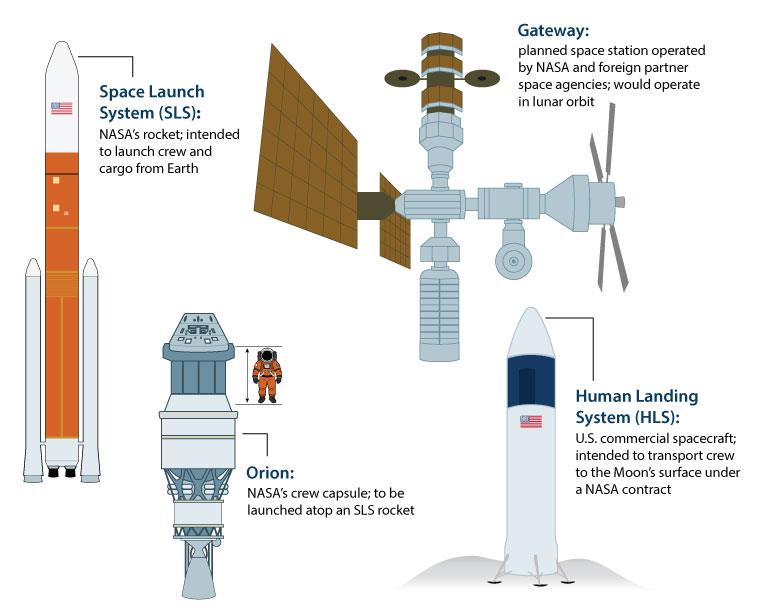
Artemis 3 is the US’s grand attempt to land humans on the south pole of the moon, a location thought to contain the valuable spacefaring resource of water in the form of ice. In 2021, NASA partnered with SpaceX, awarding them a contract to develop a lunar lander for the Artemis program. Artemis 3 would travel to lunar orbit and rendezvous with the HLS (Human Landing System), which would bring two of the four crew members down to the south pole of the moon. However, after a visit to SpaceX’s Starbase facility in September, NASA officials are worried that the HLS will not be ready for Artemis 3’s current launch date of mid-2027. Following the visit, NASA administrator Sean Duffy announced that the organization may turn to other private spaceflight firms for the lander contract. However, the process of selecting a new partner and undoing the contract with SpaceX may take even longer than resolving the issues with the HLS.
Compared to NASA’s delay-ridden progress, China’s lunar program has been a steady march. The Chang’e (CHAHNG-uh) program, named after the Chinese moon goddess, began in 2004, decades after the first space race. However, with a launch at least every six years, the program has completed six lunar missions in the past two decades.
In May of 2023, Chinese government official Lin Xiqiang announced that China planned to land humans on the moon by 2030, just three years past NASA’s tenuous 2027 target. Less is known about China’s exact mission plans than Artemis’s, but we do know of three components. In June of this year, China performed a successful test of the spacecraft’s launch escape system. On August 6, the China Manned Space Agency successfully conducted a simulated landing and takeoff of a mock lander. And on August 15, a 10-second test firing of the rocket’s center core passed without any difficulties. Thus, China has made progress in all three elements of its lunar mission, whereas NASA is facing delays in all of theirs.
Humans are returning to the moon soon. Whether they are Americans or Chinese remains to be seen. Beyond the geopolitical tensions on Earth, we must consider what this new space race reveals about the nature and future of space exploration. When they only serve as a competition between nations, are programs such as Artemis even worth so much money and risk? I believe they are. Space exploration drives technology forward, unites humankind in a shared pride. We went to the moon not because it was easy, but because it was hard, and the same will be true when we go back.