






































![[ERROR]: Lack of Women in the Software Industry](https://theechohsmse.com/wp-content/uploads/2024/12/APC_0280-984x1200.jpeg)







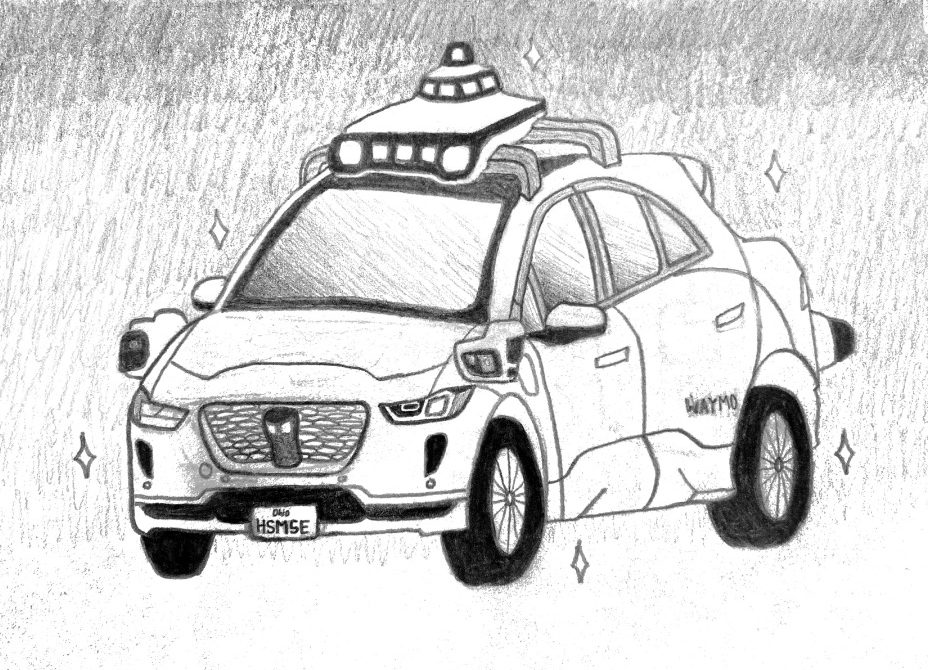
For a long time, self-driving cars have been seen as nothing more than an element of science fiction. Like travel to Mars or nuclear fusion, they’ve been thought of as belonging more to the future than the present. They were something that would always exist ten years from now, no matter how many years passed. By now, like so many technologies before them, they’ve jumped from the realm of sci-fi into that of reality. In many of the largest cities in the country, you can hop in a cab and go for miles and miles without anyone behind the wheel, and more than ten million people have done exactly that.
The charge has been led by Waymo, a subsidiary of Alphabet, the parent company of Google, which has revolutionized self-driving cars. Now, they want to expand into New York City, and while Governor Kathy Hochul seems to be supportive, Mayor Zohran Mamdani seems to be more skeptical. Most people in the city agree more with Mamdani, however, with 45% believing self-driving cars should remain illegal, compared to just 34% of New Yorkers who think they should be legal, according to a recent poll. This view is also well represented in our school: “I think that we are not advanced enough to make sure no accidents happen,” said Taha Usha (’27). This perspective isn’t limited to just New York: According to a poll from The Argument magazine, Americans support banning self-driving cars 41%–28%. Notably, however, support for self-driving cars was significantly higher in areas where they already operated. This shouldn’t be a surprise, though. The most common concern surrounding Waymos is their safety record, but virtually all of the data shows that Waymos aren’t just as safe as human drivers, but are orders of magnitude safer.
Allowing Waymos into New York City isn’t just a good idea; it’s a moral imperative. That might sound like a big claim, but it’s true. For starters, the NHTSA estimates that almost 40,000 people died in traffic accidents in 2024, the lowest number since 2019. For reference that’s only 7,000 less than the number of Americans who died in combat during the entire Vietnam War. Worldwide, traffic accidents are the leading cause of death for people between five and 29 years old. If we could find a way to reliably reduce traffic accidents, it would be one of the greatest public goods of all time.
Waymo is legally required to report all crashes that their vehicles get into to the Federal Government. Waymo’s own analysis suggests that, compared to human drivers, they get into 82% fewer crashes where an airbag is deployed, 81% fewer injury-causing crashes, 92% fewer pedestrian crashes, 83% fewer cyclist crashes, 80% fewer motorcycle crashes, and 90% fewer serious injury crashes, which are defined as crashes reported to the National Highway Traffic Safety Administration as either causing fatalities or serious injuries, under its Standard General Order on Crash Reporting. Of course, it’s prudent to take a company’s own data with a grain of salt, but experts largely agree that their methodology is credible. The papers they publish are peer reviewed, and the safety reports on their website have been praised by the Insurance Institute for Highway Safety. In addition, all the raw data Waymo collects is made publicly available, allowing for independent analysis, which has largely corroborated Waymo’s findings. Waymo also publishes much more data than other autonomous vehicle companies, who typically publish little more than what is legally required. All this to say that these statistics are likely accurate. A world with 90% fewer serious injury car crashes is a world with over one million saved lives every year, according to the World Health Organization. That’s about 1.6% of all deaths worldwide. This is a world that we should all strive to reach, and New York allowing Waymos is a critical step toward reaching that world. New York is the most populous city in the United States, and one of the most famous ones in the world. A Waymo success story here would inspire other cities around the world to follow our lead and fast-track the amount of lives saved.
Some may argue that the best way to reduce traffic casualties is to develop and build more mass transit. While I am a massive supporter of mass transit systems, which are both safer than driving and significantly improve economic conditions, America as a whole seems to be both unwilling and unable to change its car dominant culture. 75% of Americans commute by car, and few cities have robust transportation systems. It’s also exceedingly difficult to build public transportation in modern America. When California tried to build high-speed rail, it wound up being delayed by around ten years. Even in New York City, the gold standard for public transportation in the United States, it took ten years to build only three subway stops. The first 28 subway stops the city built took four years. All over the country, transit projects face massive delays and cost overruns. To be clear, these problems are solvable, not inevitable. But to create a system in which Americans can truly rely on public transit would take massive investments and strong, long-term dedication to the project. As of this moment, the political will for these things does not exist, and I doubt it will anytime soon. Waymos, by contrast, don’t need infrastructure or much public investment. You put them on the road, and they can drive. Besides, even if we do get a truly great public transit system in this country one day, there’s no reason they can’t coexist with Waymos. People still drive in New York, the city with the best public transportation in the country, even if less than in other cities in the country, so introducing Waymos would still improve safety.
The principal concern of Mamdani surrounding Waymos seems to be the potential job losses they would cause in the city’s taxi industry. However, it’s nowhere near an inevitability that Waymos would cause job losses; The Economist found that the number of people working for taxi services in San Francisco grew by 7% in 2024, after the introduction of Waymos. Nevertheless, this is a valid concern. If we do assume that Waymos would cause job losses, then that is obviously a terrible thing, with serious effects on people’s lives. But it’s also the nature of society that certain jobs become obsolete with time. A computer used to refer to a person who did manual calculations, rather than a machine. Imagine if we had blocked the development of computers over concerns that they would take away jobs. Or if we had blocked the development of cars because of concerns over the jobs of horse taxi drivers. Not only would the world be worse off, but there would also be significantly fewer jobs! It’s almost impossible to accurately predict the long-term impact of transformative technology, so when a new technology offers to save lives and undeniably improve the world, it makes no sense to block it over employment concerns. A cure for skin cancer would save less than one-third the lives Waymos could save. Would we reject it because it threatens the jobs of dermatologists? The fact of the matter is Waymos aren’t going anywhere; the question is whether we embrace them and the opportunities they provide, or stubbornly resist.