















![[ERROR]: Lack of Women in the Software Industry](https://theechohsmse.com/wp-content/uploads/2024/12/APC_0280-984x1200.jpeg)




While most of the media attention in 2026 will no doubt be allotted to the flashy federal midterm races, including the wide open NY-12 congressional district election in central Manhattan, there will be plenty of other important races. In particular, every single seat in the New York State Assembly will be up for grabs. The New York State Assembly is the lower legislative body of New York, which introduces and passes laws and provides extremely important oversight over the workings of New York State. HSMSE is situated just above the 69th District of the State Assembly, which is currently represented by Micah Lasher. Lasher, however, is running for the aforementioned NY-12 seat in 2026, leaving the field wide open for a successor.
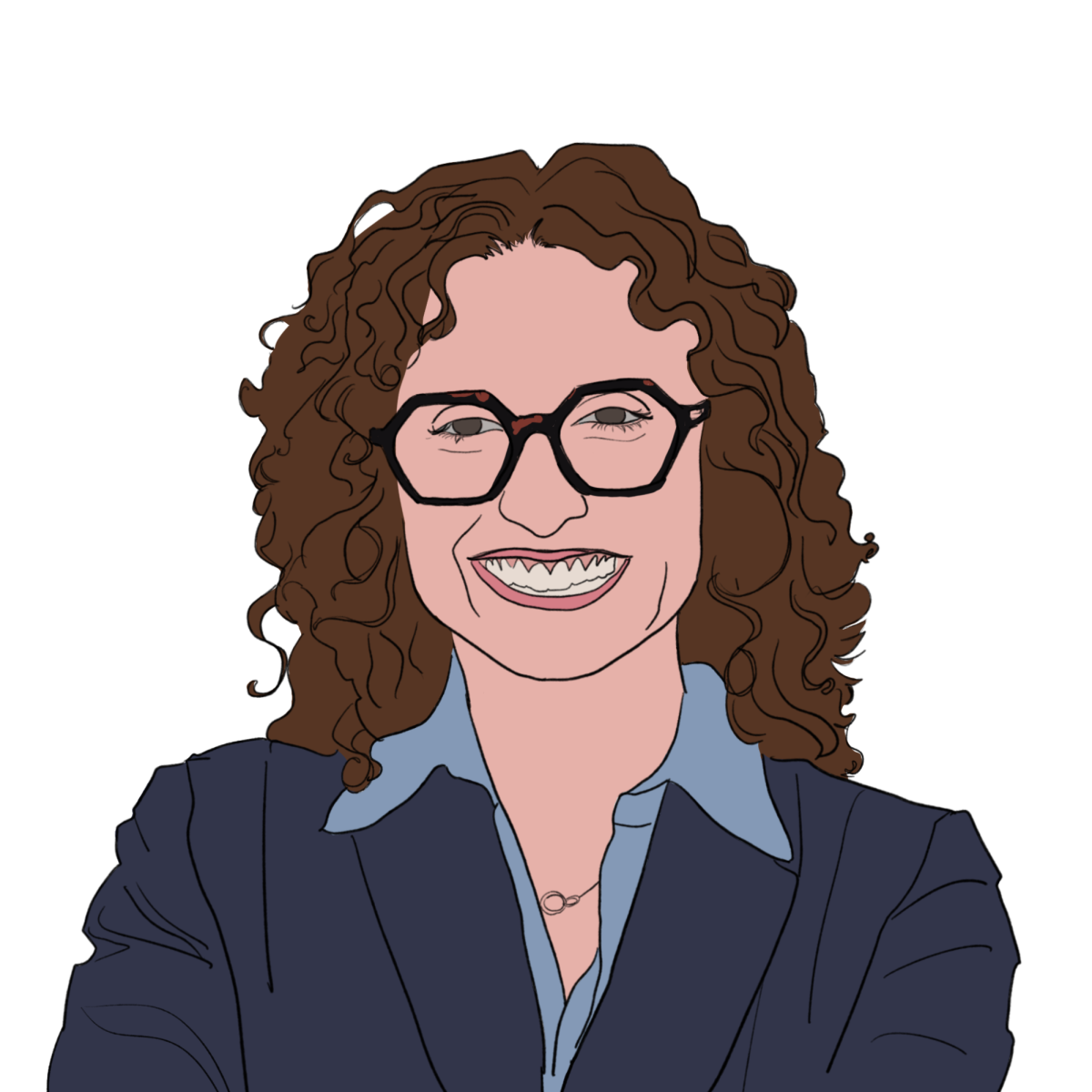
One candidate running is Rabbi Stephanie Ruskay. She has been endorsed by City Council Member Shaun Abreu—who represents the 7th New York City Council District, which overlaps with much of the 69th State Assembly District—and by former Manhattan Borough President Ruth Messinger. Most importantly, she is a member of HSMSE’s parent community.
This interview was conducted on December 15, 2025, before Zohran Mamdani was inaugurated as mayor. It has been edited for brevity and clarity.
Yalli Zussman: Rabbi Ruskay, thank you so much for joining us. Why don’t we start with you introducing yourself, telling our readers a little about who you are, what you do and what you’re running for?
Stephanie Ruskay: My name is Stephanie Ruskay; I’m a Conservative Rabbi. [Editor’s note: “Conservative” in this context refers to the Jewish denomination, rather than the political ideology.] I serve currently as the associate dean of The Rabbinical School at the Jewish Theological Seminary, and I lead our Center for Ethics and Justice. I have always been engaged in service and justice, and as a rabbi, I do a lot of multi-faith work in our neighborhood. It feels like we’re living in a time when all of us have to do more. I feel particularly moved on two issues. One is immigration: We are living at a time when people are being picked up and disappeared, when they have a legal right to be here, when they’re following the process. The way the country is doing it I think is unacceptable, and I want to be a person who is part of making it better. Another issue is housing. Like lots of people, I rent an apartment, and rents are high. There’s no housing stock, so if you need to move to a less expensive place, there’s nowhere to move. I don’t think it’s healthy for the city. Institutions can’t thrive, people can’t move in, grow their families, kids can’t come back after college. There’s just no room currently, so I want to be part of making the city more accessible to all and livable to all.
YZ: The SHSAT is embedded in state law, and there always seems to be a lot of discussion around whether the admissions process is fair, whether it should be revised, or even completely overhauled. Do you support any changes to the admissions process for specialized high schools, or would you like to keep it as is?
SR: I especially support creating affordable access for everybody to be able to prepare for the test. If you’re going to have a test, we know that people who can afford to have special tutoring and preparation are much more likely to have a leg up in the process of getting in. So I think having free, high-quality training that’s available to everyone is important. If someone is going to a specialized school, it should be because they excel, not because they have money for a tutor and someone else doesn’t.
YZ: There’s also a lot of issues New York and the country as a whole [are] facing around education. According to the Nation’s Report Card, which is the Department of Education’s benchmark for measuring students, only 37% of fourth graders in New York were at or above proficient in math, below the national average, and only 30% were at or above proficient in reading. What changes would you like to see New York State implement to improve education and these results?
SR: I assume that there is some link between how much time kids are spending on screens or phones, playing games. Some of it probably requires legislation and some of it requires messaging and education, and shifting culture that may be beyond law. I don’t think you can legislate your way out of a social problem. So I agree that it’s an enormous challenge, and we want to be increasing the capacity of kids to perform in really important subjects. I think that everybody—including and especially the kids who are doing the learning—have a lot to say about their own experience. So I think it has to be a communal conversation. I would really like to hear from some of the kids, about how the grown-ups can make things more conducive for them to learn. I’m not saying that kids have to solve the problem—we lean on kids to solve a lot of social problems which are heavy, but I think we have to take ideas from everywhere, including from kids.
YZ: As you know, New York State enacted a law restricting students’ abilities to be on their phones during school hours. What are your feelings on the law a few months in as a parent, and as someone who’s running to be a legislator?
SR: I think it’s complicated; it’s certainly a source of friction in our house. I have twins, and at your school I don’t think they take them, but at the other school they put them in Yondr pouches … people spend a lot of time trying to outsmart the Yondr pouch, which makes them creative, but not in the way that you want. So I would say that everyone has to be a stakeholder in the conversation. I think that people do better when they feel like they’ve had input in the solution. But I also think that we’ve lived for many years without people having their phones on them all the time, and in some ways it’s an addiction that most of us have. I understand for emergencies there are reasons for people to want to have them. [At] the school my other son goes to, before the Yondr pouch they had something called a phone hotel, where everyone would put their phones in a shoe box. My hunch is that it was a good solution … but I think it’s an everyone challenge. Parents have to be a part of it, kids have to be a part of it, teachers have to be a part of it. But I think having phones in school is incredibly distracting, it’s hard for kids to do their best learning when they have their phones with them.
YZ: We have a lot of students who commute to school via public transit. For a long time now, there have been infrastructure projects, such as the Second Avenue Subway, which continuously get delayed and have enormous cost overruns, as well as delays in regular subway service in terms of repairs. Are there any policies you would support to improve things in the MTA?
SR: I share your desire for fewer delays. I think the city probably has more ability to act, but I would support moving forward with the Second Avenue Subway. I think public transportation is incredibly important. I am interested in seeing how the next mayor makes getting around the city less expensive and easier.
YZ: One of the principal campaign promises of the mayor-elect has been to make buses free. That would require state-run cooperation because the MTA is a state-run agency, so would you support free buses?
SR: First of all, I want to mention that you [HSMSE students] all get OMNY cards for both the bus and the subway, and I’m a big fan of them. I’m interested in expanding it, not only to students who live a certain distance from school but for all students, because you can use it on the weekends; it’s good for internships, it has enormous value in terms of equity for students. So I am in favor of increasing access in order to be able to get around. I am interested in free buses; I am curious to see how it would work financially. I am excited to see [Mamdani’s] plan. I don’t fully understand how it would work, so I’m ready to listen.
YZ: We’ve seen some recent moves by the Trump administration around dissolving the federal Department of Education, which provides very important programs and research around education. What do you think we can do on a state level to mitigate the impact of abolishing the Department of Education?
SR: That’s another thing I feel horrified about happening in my lifetime. I think that it’s doing irreparable damage to the country. States can figure out how to cooperate and do some research, but it’s really a needless loss for the country, and we’re all going to pay the price. I would be in favor of rebuilding the Department of Education as soon as we are able, and in the meantime, I think you have to, at the state level, pick some pieces to work on and find partners in other states. I don’t know if anyone is talking about doing that; honestly, I feel like we’re living in a time that we haven’t faced before. My approach to solving problems is that you have to try a lot of things and some of them will work and some of them won’t work. You keep moving forward.
YZ: On a different note, it’s been almost a full semester. How do you feel about being a parent at HSMSE?
SR: I feel very happy. I think my son is getting a great education. [HSMSE is] a great community … I am thrilled that it exists in the city.
YZ: Rabbi Ruskay, thank you very much. Is there anything else you’d like to add before we go?
SR: Thank you. I appreciate you inviting me in and making me part of the HSMSE community. I would also say that I’m sorry that the world is the way that it is right now, and you and all the other students at your school are having to live through such a tumultuous time. I think we owe it to you to keep fighting and make this state as humane as it can be, and wait for the moment [that] we can work in a national way.