
































![[ERROR]: Lack of Women in the Software Industry](https://theechohsmse.com/wp-content/uploads/2024/12/APC_0280-984x1200.jpeg)







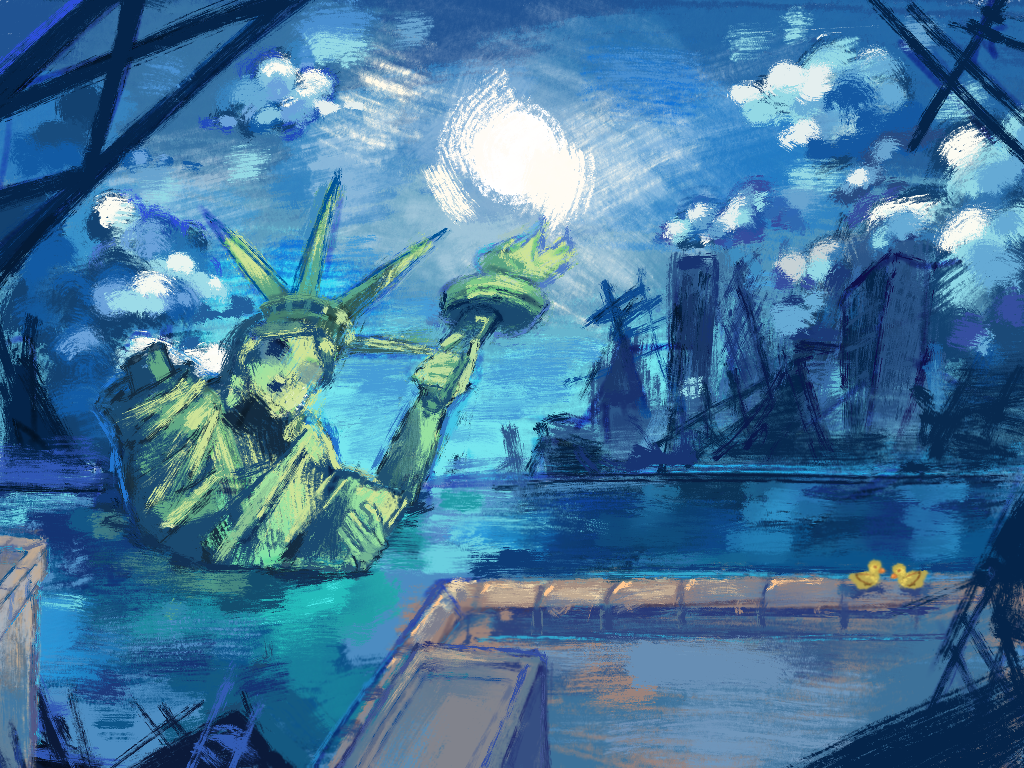
The myth of Atlantis is a legendary tale written by ancient Greek philosopher Plato in his dialogues “Tiamaues” and “Critias.” According to the myth, Atlantis was a rich, prosperous island ruled by the sea god Poseidon and his mortal wife Cleito. The island initially followed a strict moral code, despite enjoying great wealth, but as time passed the rulers (Cleitos’s descendants) became corrupt and greedy, seeking conquest over other nearby lands. Following their defeat by Athens, Poseidon punished Atlantis with catastrophic storms, which sank the island. Today, humans degrade the environment through air, light, plastic, water, noise, and land pollution. Consequently, a frequent loss of biodiversity, soil and water degradation, and natural disasters lead to rising sea levels. Cities are beginning to sink and resources have become more scarce. Is this nature’s way of punishing humans for their greed and destruction?
In 2024, the average global surface temperature was 2.3 degrees Fahrenheit warmer than the 20th century base line. Although 2.3 degrees may not seem like a big difference, it has large impacts on our environment: increasing the number of coastal floods every year, the rate at which water expands, and the number of heat waves annually. In Hilo, Hawaii, the average number of coastal floods between 1950 and 1969 was around 0.35, but during the global temperature increase, the average number of coastal floods increased to around 14.08 in the years 2010–2023 (information for 2024 is not yet available). This huge increase in coastal floods is most likely caused by the rising of sea levels and warmer water temperature. Warmer air can hold more moisture, increasing rainfall, and warmer oceans can create tropical storms, resulting in more powerful winds.
Additionally, the increase in temperature greatly speeds up the rate at which our ice caps and glaciers are melting, through a phenomenon called Arctic amplification. This is because of the Albedo effect: Ice and snow are highly reflectant, bouncing solar energy back to space, but when that ice melts, it reveals a darker ocean, which absorbs more solar energy, heating up the surrounding water and ice. The melting of ice not only increases Earth’s surface temperature but also causes sea levels to rise.
Another factor that increases sea level is water expansion. Water expansion is the phenomenon where water absorbs thermal energy, exciting its molecules and increasing water volume. As a result, the higher sea level enables floods to travel further up coasts since the additional water extends its reach inland.
How does this impact NYC? Unfortunately, NYC is a coastal city, which means it will undoubtedly be affected by coastal flooding, storms, and rising sea levels. From 1950 to now, NYC’s sea level has risen roughly nine inches. Although this increase does not seem like much, it causes more flooding, especially during big storms. Streets, subway tunnels, and buildings near the coast now flood more easily than they did in the past. Additionally, the city is also slowly sinking because of the weight of buildings and soft ground, which makes the flooding even worse. When heavy rain or hurricanes hit the city, the water has nowhere to go, allowing it to reach places which otherwise would have stayed dry. If sea levels keep rising, parts of NYC could end up underwater and some neighborhoods might not even be safe to live in anymore. By 2050, it is predicted that the water level may rise up to 2.5 feet, putting parts of the city at risk of submerging.
To stop NYC from sinking so fast, people around the world should reduce, reuse, and recycle to decelerate global warming, which will prevent sea levels from rising and prevent harsher storms. Cleaner energy would also prevent carbon emissions, and reduce the amount of resources used. This would not only benefit NYC, but other coastal cities around the world. There are many ways to keep our environment safe: doing our best to not pollute so we can mitigate global warming; building sea walls, which protect the coast from flooding and erosion, and building dikes, which redirect water so it doesn’t reach places where water is unwanted.