









![[ERROR]: Lack of Women in the Software Industry](https://theechohsmse.com/wp-content/uploads/2024/12/APC_0280-984x1200.jpeg)





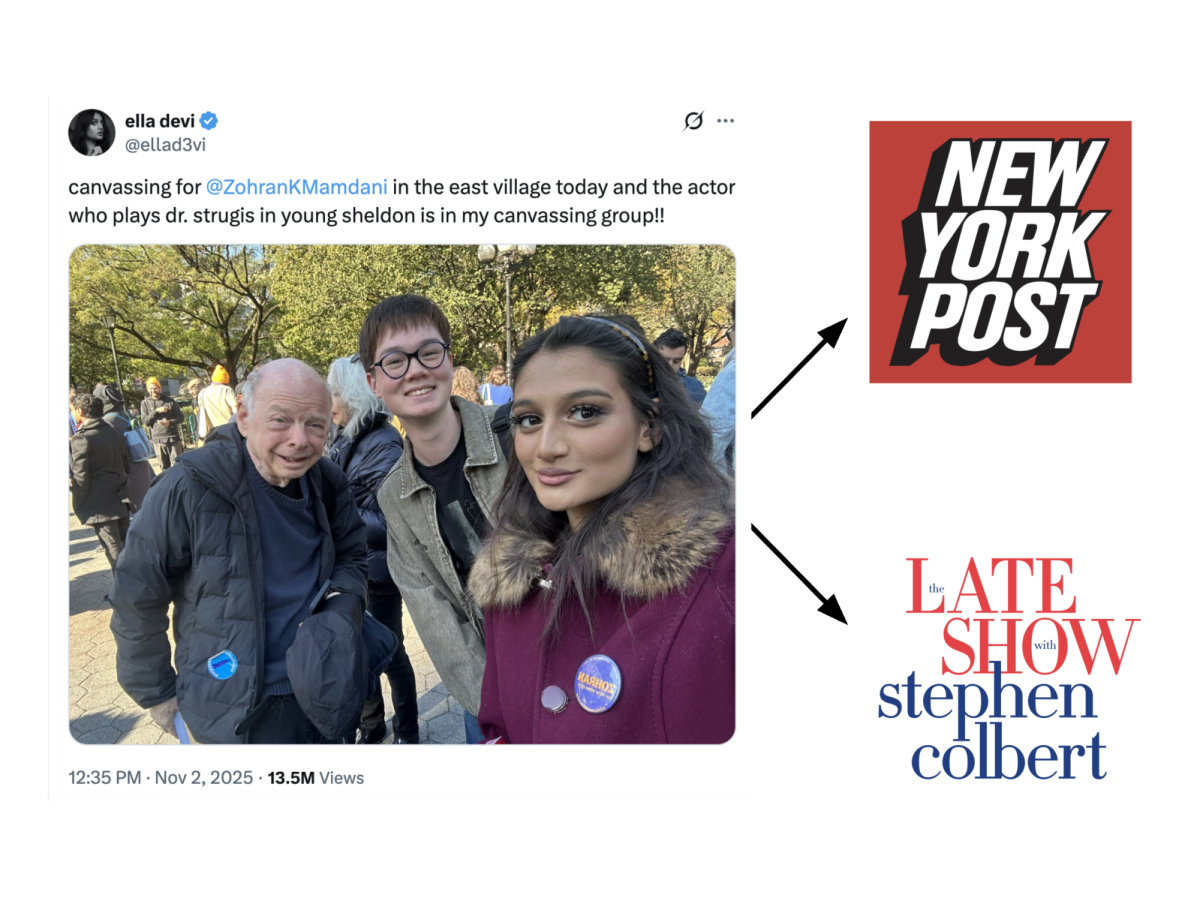
On November 2, 2025, just before knocking on nearly 100 voters’ doors, Ella Devi (’25) and I snapped a picture with acclaimed actor Wallace Shawn. We had no idea that its online views would come to surpass the population of New York City.
While attending HSMSE, Ella Devi was The Echo’s Arts and Culture section editor, and she photographed for and co-wrote many articles on student activism with me. But she’s best known online for her commentary on fashion and politics, with tens of thousands of followers across TikTok, X (formerly Twitter), and Instagram as @ellad3vi.
She captioned our photo on X, “canvassing for @ZohranKMamdani in the east village today and the actor who plays dr. strugis in young sheldon is in my canvassing group!!” Although Shawn was in our circle of volunteers when we were given instructions, we soon split off into pairs to cover various areas in the neighborhood.
Carrying bilingual door hangers and a list of talking points detailing Mamdani’s platform, Ella Devi and I headed to two buildings in the StuyTown complex. The MiniVAN canvassing app showed us which voters to speak to, alongside their demographics and apartment numbers. We asked those who answered their doors about their voting plans; the majority supported Mamdani, though one person shouted at us to leave after we introduced ourselves.
Meanwhile, Ella Devi’s X notifications exploded. Users reacted to her recognition of Shawn only from Young Sheldon with a mixture of support, outrage, and belittlement. Some claimed we were too young to know his roles in other productions—or to understand politics. @PhilipTerzian wrote, “Comforting to know that the younger semiliterates of New York — Zohran Mamdani’s base — haven’t the slightest idea of the actor’s name” (both “semiliterates” in question being award-winning journalists).
At the end of our three-hour shift, Ella Devi’s post had accumulated hundreds of thousands of views on X and had spread to other platforms—including Bluesky, Threads, and Instagram.
“Wallace-gate,” as she deemed it, quickly got attention beyond social media. After we wrapped up in StuyTown, Ella Devi hurried to Union Square for an in-person interview with the Washington Examiner. Emily Sundberg of Feed Me also spoke to her that night. Meanwhile, the Mamdani campaign surpassed 150,000 doors knocked in one day and our X views climbed into the millions.
The following day, the New York Post featured Ella Devi’s tweet in an article titled “‘Hot Girl for Zohran’ gets mercilessly trolled for failing to recognize legendary actor: ‘Inconceivable!’” It focused more on Ella Devi’s alleged incompetence than on the canvassing itself—mocking her as a “self-described ‘socialist socialite,’” while acknowledging Shawn’s “long history of socialist politics.”
Ella Devi learned about the article during her Poets as Philosophers class at The New School. “I could not keep my face from contorting into a laugh,” she said. She responded swiftly on X, “favorite part about this article: i have never referred to myself as a hot girl for zohran, the new york post just decided to bestow that honor on me.” (Hot Girls for Zohran was an organic group of Mamdani’s volunteers with which Ella Devi was unaffiliated until they saw her tweet, gifted her a T-shirt, and invited her to their victory party.)
On election night, Stephen Colbert featured our picture with Wallace Shawn on national television, poking fun at people’s inflamed reactions. “He’s most known for portraying persnickety debate teacher Mr. Hall in the movie Clueless … to know him from any other role would be ‘Inconceivable!’” Colbert said, referencing Shawn’s character in The Princess Bride. Ella Devi and I found out from Ms. Hesseltine, who watched it in real time. People we knew in real life generally voiced support.
Online, however, the right wing engaged in extreme harassment. Strangers on X called both of us a shocking variety of racist, homophobic slurs and other pejoratives. Interestingly, people only targeted the two of us, even though Wallace Shawn was supporting the same cause. Our differences from him in age, race, and sexuality seemed to stoke much of the discourse that made us viral.
Ella Devi—who received around 50 million X impressions between October 26 and November 9—posted the original tweet without sharing my name explicitly, so she experienced the worst of it. “I saw a few [AI] deepfakes of me, like, progressively removing more clothing,” she said. “One of them was so graphic that I felt like I didn’t even want to share it with anyone.” She was also told that she was “not an American” and that “Iran would be a better fit for [her].”
Even so, “[Mamdani’s] win really signified to me that Brown people like me aren’t going anywhere,” Ella Devi said. With every rape and death threat she received, she signed up for another canvassing shift.
As a journalist, I’m used to casting the spotlight, not occupying it. My experience of virality has veered between awe at the numbers, revulsion at the slurs, and laughter at the absurdity of it all. But, aftermath aside, I am proud to have canvassed for Mamdani. His refusal to sacrifice the New Yorkers most overlooked by mainstream politics has invigorated me, and I hope his success inspires us all to work towards the more liveable and just reality that we deserve.