

































![[ERROR]: Lack of Women in the Software Industry](https://theechohsmse.com/wp-content/uploads/2024/12/APC_0280-984x1200.jpeg)






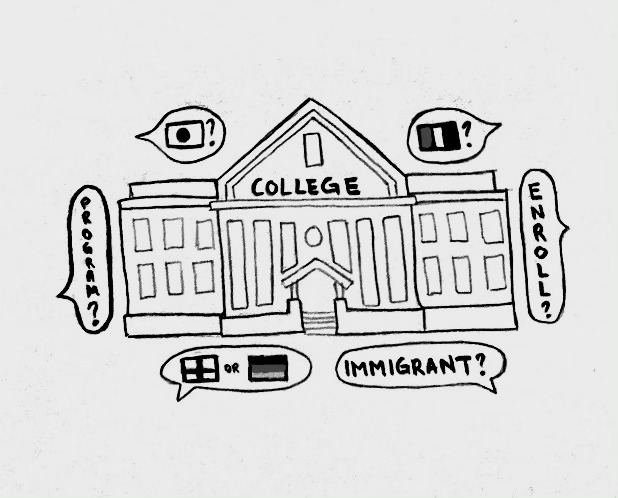
The college process is stressful and confusing for most people. But, in these times, for some students in immigrant families, fear mingles with the stress and confusion.
Many students at HSMSE are immigrants or have parents or guardians who are. And some of the members of HSMSE’s immigrant families may be undocumented or have other precarious immigration situations. Under the current presidential administration, policies about immigrants have become much more aggressive, with mass deportations and denial of access to things like health insurance and nutrition aid. As seniors dive deeper into the college process, handling the Free Application for Federal Student Aid (FAFSA) forms, the CSS profile, and facing questions about citizenship status and social security numbers, fear mingles with the pressure of college applications.
The Echo reached out to several organizations that address immigration issues to ask how the current policies might affect a student’s college process, particularly in relation to financial aid. Unfortunately, fear is not only an issue for students engaged in the process but also for those who serve them: Some organizations said they could not speak on the record at this time; others responded from personal rather than work emails.
From publicly available information and some personal interviews, however, The Echo found a general consensus: Although students should be careful about how they reveal information, many colleges and universities are willing to work with students to ensure that their immigration status does not stop them from accessing higher education.
Please keep in mind that the situation is changing very quickly; this information addresses the timeframe of late September 2025.
The FAFSA
No one likes filling out the FAFSA, which most colleges and universities require for students applying for financial aid. But for immigrant students, an added concern is that the FAFSA requires students to include their parents’ social security numbers—which undocumented parents often don’t have. In a time of increased detention and deportation of undocumented people in the United States, the thought of exposing one’s parents can be incredibly scary, even though the FAFSA has traditionally been viewed as safe because the Higher Education Act (HEA) of 1965 prohibits the use of student FAFSA data for purposes other than determining aid eligibility and amounts.
This has been true for more than half a century, since the HEA and the Family Educational Rights and Privacy Act of 1974, known as FERPA (which many of us recognize because FERPA also covers our rights to view our records, which students are asked to waive when filling out the Common App).
But, on November 25, 2024, The National College Attainment Network (NCAN), an organization that has worked to increase equity in postsecondary degree access since 1996, posted a message saying that it was not sure that this FAFSA information would remain protected.
It read, “We believe mixed-status families should make a considered decision about whether to submit identifying information to the federal government in an FSA ID or FAFSA. This guidance may be particularly relevant to mixed-status families who would be participating in the federal aid application process for the first time. NCAN understands the grave ramifications of this guidance and deeply regrets that we feel it is necessary to issue it.” (An FSA ID is a unique identifier for students and parents to access their federal student aid information).
Understanding the risks
Most of the students who worry about the FAFSA are U.S. citizens or permanent residents, since not many immigration statuses qualify a student to receive federal aid. But that is still a lot of students: More than half of New York City households have at least one immigrant parent in the family, and the NYC Mayor’s Office of Immigrant Affairs’ 2023 report on immigrants in New York assessed that approximately 205,200 United States citizen children live with undocumented family members.
As one university aid advisor The Echo consulted said, although FAFSA does require both students and parents to input sensitive information, it’s likely that they have already surrendered such information before, for medical reasons, employment forms or tax filings. To put it bluntly: Filling out the FAFSA form will not be where the government catches you or your family, if they do at all. And the reward, financial aid, can be life changing. Student debt is no joke.
What if a student is ineligible for federal financial aid?
Financial assistance for college is still within reach as systems adapt to accommodate the increased anxiety. Private universities often have the resources to circumvent the FAFSA and fund a financial aid package themselves. And many use the College Scholarship Service Profile (CSS) to make aid determinations. This system is maintained by the College Board, not the government, and inputting a social security number is optional.
At one prestigious university with a substantial endowment, in response to a query from The Echo, a financial counselor said that any student with concerns about immigration status should call the financial aid department. “Don’t put anything in writing,” the counselor warned, and they stressed that their institution would try to work with the student to get the information both parties needed. At HSMSE, Ms. Barnewold, the guidance counselor for the senior class says that any student who wants help in reaching out to college can come to her for confidential assistance. There are also other national programs that provide private aid.
Here in New York, we have a number of programs that enable students who are neither U.S. citizens nor permanent residents to access aid for college. The José Peralta New York State DREAM Act was written by a group of undocumented students and passed by the New York State legislature in 2019. It provides access to New York State–administered grants and scholarships for students with non-permanent immigration statuses, including those who are undocumented. Students who have attended or graduated from a New York State high school (or attended a high school equivalence program) are eligible.
Some of the scholarships the DREAM Act opens access to include the Excelsior Scholarship, the Tuition Assistance Program (TAP), and other state-administered scholarships. Students are also counted as “in-state” when applying to New York’s public universities, making tuition cheaper.
Outside of New York, there are a number of other states that do not consider a student’s immigration status for state universities—National Immigration Law Center has a great Higher Education for Immigrant Students toolkit that tracks state laws concerning non-citizen students.
There are many different immigration statuses within a single family. And even within that status risks may vary depending on a family’s history. Every situation is different and families should make informed choices. For advice about your specific situation, please contact a legal association, like The Door, or colleges’ immigration centers.