
































![[ERROR]: Lack of Women in the Software Industry](https://theechohsmse.com/wp-content/uploads/2024/12/APC_0280-984x1200.jpeg)




Fat: The two common types of fats used in baking are liquid fat and solid fat. Examples of liquid fat are all kinds of oil (vegetable, olive, avocado, etc.); solid fats are things like butter or shortening. Butter is often the first fat that comes to mind when baking, and for good reason. Butter is used in a large variety of recipes—cakes, cookies, croissants, and more—partly because of its rich, butyraceous flavor, but also because of the amount of water it contains. When baked, the water in butter evaporates and creates air bubbles, resulting in a moist, tender, and fluffy pastry. The butter also caramelizes the outside crusts of croissants, giving them their iconic crunch and airy inside. Butter also inhibits gluten development; it covers the proteins in flour—gliadin and glutenin—with fat, which makes bonding more difficult, and thus creates shorter gluten chains. Some gluten development is needed when baking these types of goods, because the gluten strands hold the baked goods together, but too much turns whatever you’re making from light and tender to tough and chewy (which should be avoided at all costs!). Another type of fat commonly used for baking are neutral oils, such as canola, vegetable, and grapeseed oils. Unlike butter, which is only 80% fat, neutral oils are 100% fat, meaning that they do not add the same fluffiness that butter does because there is no water to evaporate. This results in a denser end product.
Starch: There are many kinds of flour used in baking, such as all-purpose, bread, or cake flour. When baking bread, people use either bread flour or all-purpose flour. The main difference between them is that bread flour has a higher protein content, which allows it to develop more gluten during the baking process. Gluten is made up of hundreds of proteins, but the main ones are gliadin and glutenin. The amino acids in gliadin and glutenin allow for hydrogen bonding to occur between the two when water is added to the flour. Once gluten is formed, disulfide bonds—covalent bonds between the sulfur atoms in cysteine residue—connect the multiple gluten molecules. Gluten also acts as a binder: It makes dough stretchy, fluffy, and airy. However, when making goods such as cookies or cake, people actively avoid overdeveloping gluten because it makes recipes turn out chewy instead of tender. One way people avoid gluten when baking cakes (or anything similar with a soft, fluffy texture) is using cake flour, because it has a significantly lower percentage of protein than all-purpose or bread flour. In cookies, all-purpose flour reigns supreme due to its balanced nature. The moderate amount of protein it contains (10–12%) is able to make both soft, chewy cookies and crisp, crunchier ones. For croissants, pastry flour, also referred to as T45, is typically used to create light and crisp croissants. However, bread or all-purpose flour can be used to create a more sturdy outcome.
Leavening agent: Leavening agents are ingredients such as baking soda and baking powder, and they help batter and dough rise in the oven. Baking soda, also known as sodium bicarbonate, is everywhere! One of the most famous baking soda reactions is the explosion it makes when mixed with vinegar; the rapid production of carbon dioxide results in fizzing foam residue. Similarly, in batter, baking soda will react with acidic ingredients like lemon juice, brown sugar, or cocoa powder to produce carbon dioxide; the substance rises because carbon dioxide expands in the oven. This results in thick and almost cakey cookies (or any baked good you’re making). On the other hand, white sugar has a neutral pH, meaning that it can’t go through this process (typically resulting in thinner and crispier cookies). Also, since sodium bicarbonate increases pH, gluten bonds will weaken, yielding a more tender texture. Baking soda does, however, have a slightly bitter taste, which is noticeable if you use too much. One time when I was younger, I used too much baking soda, and while my cake wasn’t completely inedible, it definitely didn’t taste as good as I would have liked.
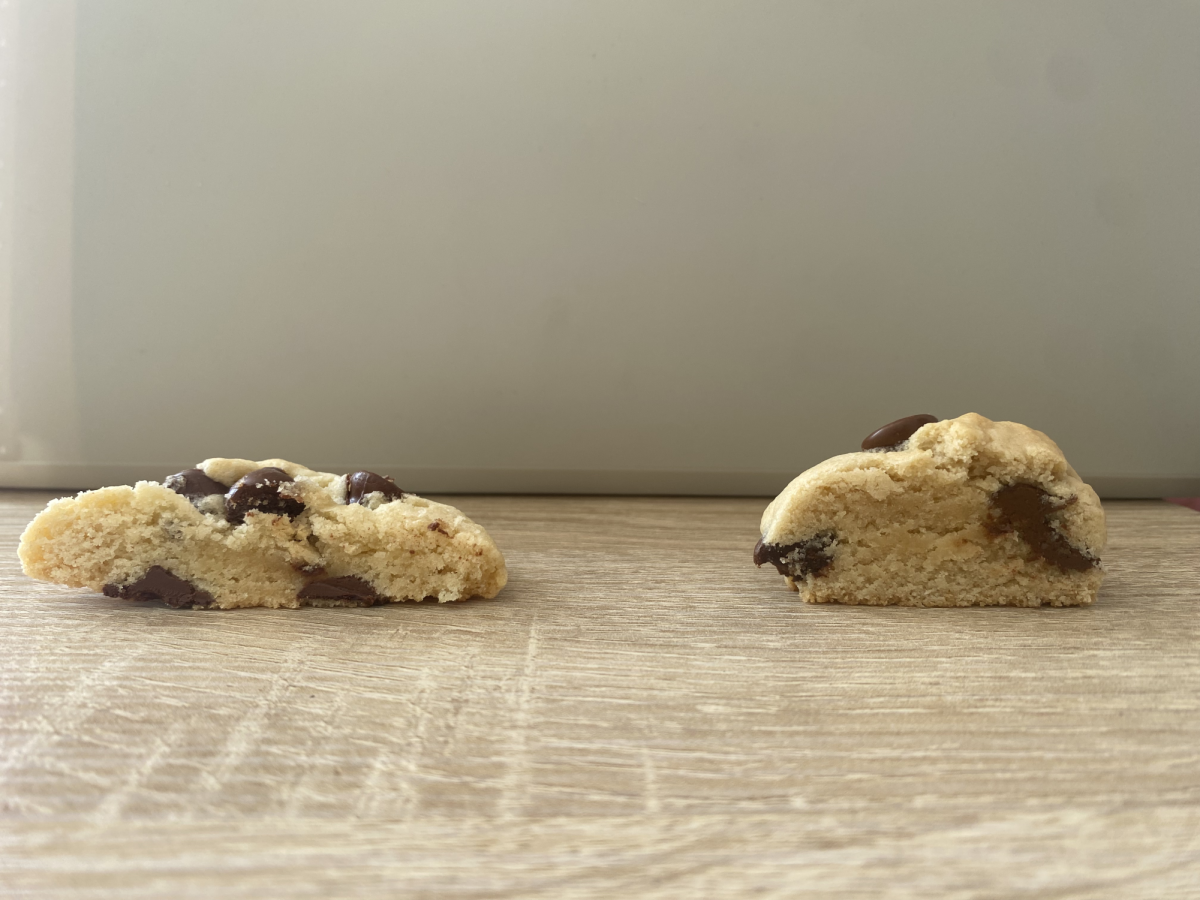
Sugar: The most common sugar used for baking is granulated sugar. There are two types of granulated sugar: cane sugar, which is made from the sugarcane plant, and beet sugar, which is made from sugar beets. Few people can tell the difference, but some prefer the faint notes of caramel or molasses in cane sugar—especially less-refined cane sugar. Light and dark brown sugar are just granulated sugar with varying amounts of molasses added; molasses adds a caramel-like flavor and rich brown color compared to white sugar, which has neutral color, odor, and flavor. Brown sugar has a higher moisture content than other sugars because of the molasses, leading to a denser and chewier product. Molasses is produced by boiling sugarcane juice over and over again, until all remaining granules of sugar are forced to crystallize due to the lack of water. Those crystals are then removed, and the substance that remains is called molasses. Known for its dark, thick, and acidic nature, molasses can be used to cut down the sweetness of regular sugar while also adding acidity, flavor, and color. Powdered sugar—ground granulated sugar—on the other hand, is typically used in recipes that require a smooth texture, such as icing; in fine-textured components like icing, the granules of regular sugar would cause a noticeable crunch in the otherwise homogeneous mixture. All sugar is considered hygroscopic, meaning its granules work together with flour to soak up moisture in the dough, but brown sugar is considered more hygroscopic because of the molasses it contains. Often, when baking things like cakes, cupcakes, or muffins, the first step is to cream together the butter and sugar; this traps air between the granules of sugar and the lumps of butter, resulting in a lighter final product. The main purpose of the sugar (in this case) is to assist in mechanical leavening, the process of physically incorporating air into batter instead of using chemical reactions, which is why white sugar is often used instead of brown sugar. Due to brown sugar’s compact and dense nature, less air can be whipped in between each granule. Since there is less opportunity to incorporate gases into the dough and less moisture is escaping through steam, it results in cookies that spread more and retain more moisture, causing the chewy texture.
Binder: Something that you will see in almost every recipe is eggs, and that’s because they work with the gluten in the flour to hold the batter together. Egg yolks also contain a lot of healthy fats, which (if you recall from earlier) means that the gluten bonds can’t form as rigidly, yielding a softer, more delicate crumb. The most common alternative to eggs is applesauce. Apples contain pectin—an organic compound found in cell walls that is used in many jams and preserves. Though apples lack the protein found in eggs, the pectin in applesauce makes it a good binding agent if you’re in a pinch or working with dietary restrictions. An outlier in using eggs are croissants, because traditionally croissants do not contain eggs; they’re only a light wash on the top in order to brown the dough in the oven. The constant lamination process of folding in butter croissant dough goes through provides enough stability that eggs are not needed.
Baking powder: While baking soda is pure sodium bicarbonate, baking powder is a mixture of baking soda, cornstarch, and cream of tartar—a powdery acid. Since it isn’t 100% sodium bicarbonate, you would need to use more in order to replace baking soda in a recipe. However, it doesn’t require a separate acid to activate; cream of tartar will already activate the reaction when the baking powder is exposed to any liquid. The leavening effect of baking powder typically happens in two stages: it activates when mixed with liquid, and then it activates again when exposed to the heat of the oven. Baking soda and baking powder don’t do all of the leavening when baking, though: Eggs act as both a binder and a leavening agent. When egg whites are beaten to stiff peaks, the proteins inside have to stretch and form an elastic web system in order to make room for all of the extra air. Thus, the egg white’s volume expands several times before baking and then the air trapped inside will expand in the oven; this technique is commonly seen when making a souffle. A similar result occurs from creaming together butter and sugar. Incorporating air into the butter’s protein causes expansion both in the bowl and in the oven.
Liquid: In almost any recipe, you’ll see milk and/or water. They are both used to hydrate dry ingredients, but water is more commonly used when making bread, in order to activate yeast. One can usually be switched out for the other in a 1:1 ratio in a pinch, but it isn’t recommended due to issues like texture, flavor, and color. That being said, milk is about 87% water and 13% solids—various fats and proteins. This means that if you were to replace water with milk altogether, your dough may not be hydrated enough to rise properly. Furthermore, the fat and proteins found inside the milk will coat the flour particles, inhibiting the formation of gluten which is needed for leavening. Conversely, replacing milk with water can dull down the flavors and mess up the texture of the finished product. It will also create a light and airy version of the baked good. In the case of bread, using only milk will result in a shorter, denser texture, because of the struggle to rise. The color will also be browner than usual due to the lactose found in milk; because the lactose isn’t consumed by the yeast, it is left in the dough and undergoes a chemical reaction in the oven. This reaction, put simply, is called the Maillard reaction, which is when various sugars and amino acids undergo a simultaneous reaction when exposed to heat, which create new flavors and colors. The Maillard reaction is known better for its role in searing a steak, roasting a marshmallow, or roasting a turkey!
At the end of the day, baking is meant to be an experiment! How do you think people discovered all of these reactions? Don’t be afraid to mess around with your recipe, and make it the way you want it to be. The possibilities are quite literally endless!