

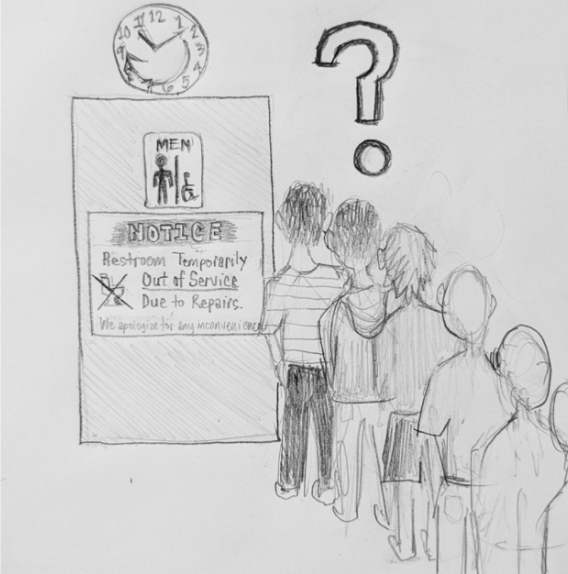
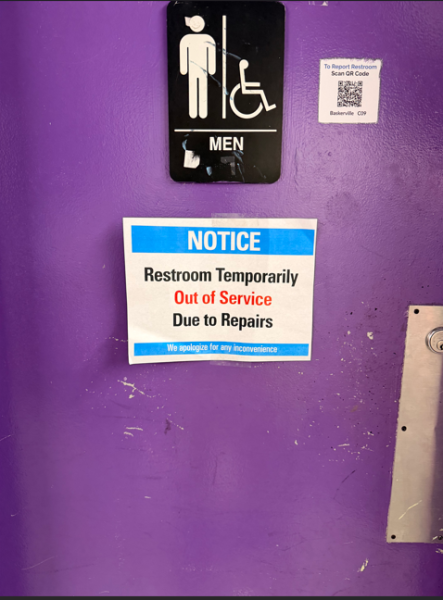
The C-floor bathroom faces right across from The Echo’s newsroom, and as of mid June, it is still closed. A sign posted outside reads “temporarily out of service,” yet the bathroom has been closed for over two months, meaning that the largest boys’ bathroom in the school is unavailable for all male students. The closure is due to vandalism in the C-Floor bathroom, something that also happened last year in what Mr. Dolcy described via a school-wide email as being “disrespectful to our community.”
In an interview with The Echo, Mr. Zara, HSMSE’s dean who deals with student violation of school policy and behavioral expectations, said that the reason the C-Floor bathroom remains closed is because of “persistent vandalism of the bathroom. For instance, there [are] no soap dispensers on the wall because there was a week where every single day the soap dispensers were destroyed. So City College is refusing to replace the soap dispensers [and] we don’t blame them.”
Currently, all 370 male students have one toilet and two urinals available on the first floor, and a single stall bathroom on the B-floor. There are other bathrooms in the NAC and in the Marshak building, available only when students are in those spaces for gym or lunch.
Many HSMSE students are frustrated that the C-Floor bathroom has been closed because it means that all the boys need to use the bathrooms on the B-Floor and first floor, which causes longer lines and more time spent waiting to go.
These delays cut into class time, leading to what Justice Repucci (’27) describes as a “cycle of doom,” explaining: “I’ve had to wait for the bathroom on the B-floor for a while [because the C-floor bathroom is closed] and it’s been really frustrating because then you’ll get back to class and your teacher will be mad at you for being out too long.”
In regards to how the school has responded to the multiple instances of students vandalizing the bathroom, Noah Leclercq (‘27) states, “I really don’t think shutting down the [C-floor bathroom] is such a great idea,” Noah said. “Because whoever messed up the C-floor could easily just also mess up the first floor [bathroom]. I don’t get what is shutting down the C-floor fixes.”
Quinten Cremers (‘26), a member of the leadership elective, describes some students’ view on the vandalism: “I think everybody is in agreement that we don’t want the restrooms trashed, and it’s not funny,” Quinten explained. “And so, nobody who does it will get any acclaim.”
Mr. Zara confirms the existence of logistical hurdles when it comes to identifying the perpetrators so that they are solely held accountable. He states, “We can utilize the cameras, [but] that doesn’t necessarily always tell you what goes on inside the bathroom… you can’t interview 30, 40 people. So that’s not going to be realistic.”
Many students disagree with the idea that they should be impacted by the actions of others: “The stupidity of one student should not lead to the suffering of others,” said Alexander Verwoert (’27).
When asked about using sign-in sheets for bathroom use or further camera surveillance of the facilities, Mr. Zara points out that the ability to curb the vandalism that results in the bathrooms being closed lies mainly with the students: “I don’t think that the staff should have to be punished because the students want to vandalize the bathroom. That seems a little bit ridiculous.”
While some students may see bathroom passes and teacher monitoring of bathroom attendance as the way to fix the issue, Mr. Zara has another perspective: “You [could] inconvenience staff by having them have to babysit a bathroom, or the students could stop destroying the bathroom… I think that it’s been closed long enough for everyone to reflect and understand that it’s much nicer having a large bathroom… I would think that maybe when we do reopen it, people will say, hey, this is a privilege that maybe we don’t want to give up again in the future.”
Mr. Zara explains the unique position HSMSE is in: Unlike other schools, HSMSE does not have its own janitorial department, but rather depends on CCNY’s. This means that for unexpected issues, whether a rock in the toilet or soap dispensers being dumped, HSMSE must request additional custodial staff be sent to Baskerville, adding strain to HSMSE’s relationship with CCNY.
Mr. Zara describes CCNY as the landlord of HSMSE and these costly expenditures damage the landlord/tenant relationship. This also means HSMSE alone can’t just reopen the bathrooms, especially when the vandalism has repeatedly happened this year.
HSMSE staff and administration are rightfully frustrated with the behavior in regards to the C-Floor bathroom. Mr. Tirado, the head of the Leadership elective, summarized the frustration: “The behavior in the boys’ bathroom over the course of four years has been incredibly disturbing.”
Ms. Hesseltine, whose classroom is in front of the bathroom, gives her perspective: “Because my classroom is so close to the bathroom, I’m often one of the people the custodians talk to about the vandalism.” Speaking of students, Ms. Hesseltine adds, “I’m usually so proud of MSE students, so it’s painful to be embarrassed when I hear what some students have done and see the impact on an individual level. The custodians want to do a good job at our school and make it a nice place for all of us to be. When we make a mess that others have to clean up, it makes it seem like we don’t value their work; it tears at the fabric of our community.” Acknowledging the joint responsibility necessary to fix the issue, Ms. Hesseltine adds, “I know not all students are responsible for what happened, but I do think we all have a part to play in trying to rebuild this relationship with the custodians and maintenance staff at CCNY.”
For CCNY, this is a problem with managing facilities. CCNY has to fund expensive repairs and replacements, and the vandalism can sometimes even result in issues of safety for which the college is responsible.
Mr. Zara states that there is an assembly being planned for the bathroom incident, and that the final details including time and location are still being decided.
In the meantime, Mr. Zara states, “If students see these things, they have to say something [but] no one’s saying anything… I understand that people don’t want to be inconvenienced or don’t want to ruin their friendships, but [continued vandalism is] ruining our friendship with the university.”
In response to whether student reporting is a feasible solution, Jacob Bayron (‘27) says, “I think some students know who it is, but I don’t think all students know who it is.” He acknowledges, however, that “I think [the responsibility is] more on the students than on the faculty.”
Ultimately, the C-Floor vandalism and bathroom closure will end the school year on a sour note if not resolved. Students are frustrated with lines and wait times, feeling like they are unfairly suffering the actions of a few individuals, while school administration and teachers are frustrated because the vandalism demonstrates a lack of respect for HSMSE’s shared accommodations. All of these concerns and perspectives must be balanced alongside having to manage HSMSE’s relationship with CCNY. Ultimately, we all need to come together and make sure that vandalism doesn’t happen in the future while allowing students to be able to use the C-Floor bathroom. With the school assembly concerning this vandalism coming up sometime in the future, this situation and discussion will surely continue next year.