

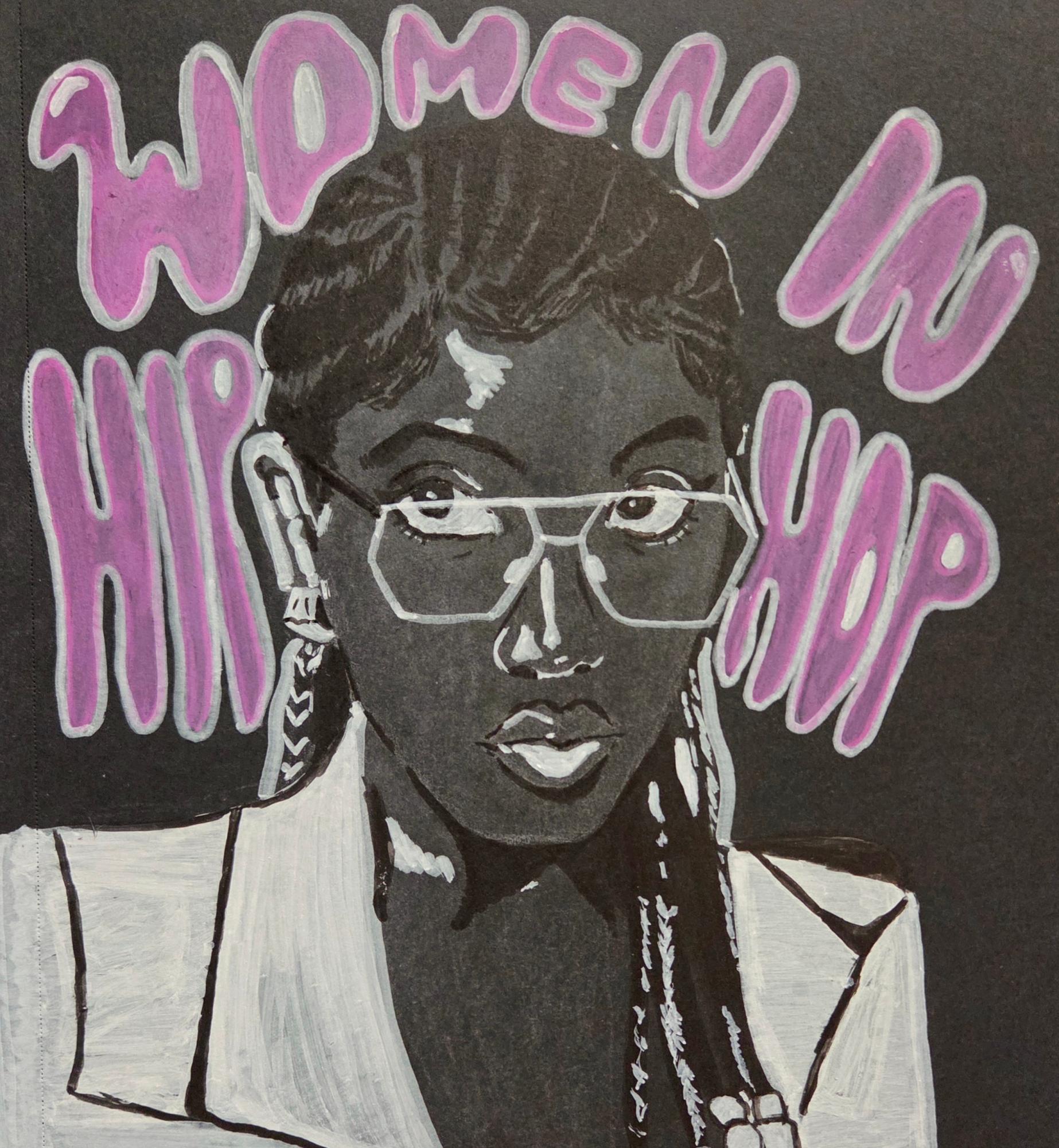
Whether you listen to hip-hop religiously or you’ve just skimmed Billboard’s “50 Greatest Rappers of All Time,” one thing is clear: Virtually none of the top hip-hop artists are women.
Though I have a lot of love for hip-hop’s early sounds, it was an era wherein women were rarely represented. Compared to their male counterparts, very few women have been able to break through in hip-hop, and they have often gone uncredited or have been treated as accessories when featured in men’s music. On the 1996 chart-topping hit, “No Diggity,” Dr. Dre received sole credit, with his name on the Hot 100 and on the cover of the CD single, despite almost-equal lyrical contributions as Queen Pen.
Ms. Lauryn Hill, undoubtedly a titan of the industry, is one of the few female rappers given the credit she deserves. Despite only releasing one album the entirety of her solo career, she is the most awarded female rapper of all time with eight GRAMMYs. In the mainstream, women like Salt-N-Pepa, Mia X, Queen Latifah, and Missy Elliot were also beloved figures of the ’90s, but even they are rarely considered “must-listens” or GOATs of the genre. Countless other women went uncredited for years despite their incredible work and influence: M.C. Lyte wrote the first full-length solo rap album by a woman, Lyte as a Rock; Monie Love, a member of the band Native Tongues spoke about societal expectations of Black women with excellent lyricism; and Sha-Rock was the first female rapper ever recorded on vinyl, yet I have rarely heard their names. Though these women are not spoken about as often as male hip-hop icons, their influence is not to be understated. In reference to hearing Sha-Rock for the first time, DMC said, “since it was a girl, the voice was so distinctive, but it sounded stronger, more grounded, more versatile, more unique, more impressive than all of the dudes that I had heard up to that point.” While some give the underground hip-hop scene credit for allowing a wider variety of voices and more creative freedom, visibility for women remains even harder.
In addition, women are objectified; even the most beloved rappers often talk about or feature highly sexualized women in their music or music videos. That is not to say that sex can’t be a prominent theme in art, but it’s important to examine the context in which sexual themes are portrayed. In “Hypnotize,” Biggie embodies the genre’s sexist culture, “rappin’ bout blunts and broads … [and] sex in expensive cars,” viewing sex with women as a symbol of status, as he and many others do in much of their music.
This constant sexualization of women and the underrepresentation of prominent female voices meant that women have been often taken advantage of. P. Diddy, for example, who formed one of the first successful rapper-owned record labels and platformed some of the biggest names in rap, was recently convicted after many years of using his influence to perform extreme sexual violence, and he was not the only one. Playboy Carti, for example, whose album I AM MUSIC debuted at #1 on Billboard charts as recently as March of 2025, has allegedly violently assaulted multiple women.
For that reason, artists like Nicki Minaj, Sexxy Red, Megan Thee Stallion, and Cardi B. are beloved by many: They write about sexuality as women, instead of writing about it as something taken by men. Lil’ Kim, a late-90s rapper, also emphasized this point: “I’ve always been super sexy and feminine. My record company didn’t understand a female rapper being sexy.”
While it is important for these women to be able to freely express their sexuality, many women feel that rap culture forces them to emphasize their sexuality for the male gaze. Queen Latifah intentionally dressed in a manner similar to popular male rappers of the time in order to avoid objectification from audiences. Because there are so few women in mainstream hip-hop, those who are active in the space receive much more scrutiny for such things. Ultimately, any expression of sexuality or lack thereof is completely valid—it is not anyone’s place to police women’s bodies nor their reactions to the sexism they face—but understanding why they choose to express themselves how they do is vital to understanding the impact that sexism in the industry has on individuals.
Nowadays, female rappers are given more credit than they once were by hip-hop fandom, but they’re often less revered than their male counterparts. When rapper Doechii won the 2025 GRAMMY in the category Best Rap Album for Alligator Bites Never Heal, she brought attention to this issue: “This category was introduced in 1989, … and three women have won: Lauryn Hill, Cardi B., and Doechii!” This year, Glorilla is the only woman out of five nominees up for the award. Zamara Kush-Cantave (’26) says that she enjoys listening to women’s hip-hop, both because she feels represented as a woman and because it doesn’t pull from stereotypes and sexism. “But I don’t know many female rappers,” she said. “I still feel like the genre and my own playlists, even, are very, very heavily dominated by men. It’s sad.”
Of course, sexism is often more nuanced than that—internalized biases are often difficult to notice and counteract. Subtle misogyny is relatively common in the industry. Kendrick Lamar, for example, has made an effort to overtly respect women in his lyrics, but these attempts have not always been successful. A lyric from “HUMBLE” stirred up controversy for praising “natural” women and criticizing others, with one article commenting, “It’s just another way to pit women against each other … This lauding of ‘naturalness’ has become more than a little tiresome.” He has also been criticized for being “performative” by accusing Drake of being a womanizer while being featured on multiple songs on I AM MUSIC.
As hip-hop is a predominantly Black music genre, “hip-hop feminism [must] focus on Black women as a culturally, intellectually and politically integrated movement.” Tupac, when speaking about his debut single, “Brenda’s Got a Baby,” said, “No Black males talk about females, we need to take responsibility for our sisters, because if we don’t, who will?” Men simply can’t cover all of the intricacies of intersectionality; it is vital for Black women’s voices to be heard in an art form whose foundation addresses the oppression of Black Americans.
While sexism is ever-present in the genre, that does not mean we should hate hip-hop or its community. It is a genre with a rich Black history, born in our very city. It has been a vital tool for some musicians and listeners alike to unpack centuries of racism in the United States, and an amazing creative outlet for others. As Aya de Leon, an instructor at UC Berkeley, said, “it’s not any special hip-hop sexism. It’s just a reflection of the garden-variety sexism of the society.” Misogyny permeates through all aspects of life, not just hip-hop, and forgoing listening to an entire genre full of incredible innovation and artisanship because of its presence would mean never listening to music again. We need to learn how to critically examine the things we love and enact change instead of giving up when we find flaws. De Leon continued, “as a feminist and a critic, I sat on the sidelines of hip-hop for many years, … kind of complaining. … And I decided that the best thing that I could do to bring my perspective into hip-hop was to become a hip-hop artist.”
Now, this sexism is changing! Though issues of representation and objectification persist, more women are being seen for their brilliant lyricism and vocals: SZA—though primarily an R&B artist—has seen much well-deserved praise from rap fans as of late, especially in the wake of her recent collaborations with Kendrick Lamar; Little Simz released her album, Lotus, in June, to critical success; and women like Doechii are unafraid to explore their femininity in songs like “Black Girl Memoir.” There are so many women innovating the world of rap right now—as they have been since its inception in the 1970s.
In reference to misogyny she faced in her career, MC Lyte said, “There may have been times when promoters didn’t want to pay me what I deserved. In a line-up, they didn’t want to put me where my songs warranted me going. But none of it affected me to a degree to where it mattered. There may have been setbacks but I never let them get to me.” So, in honor of women like her, go listen to Noname, go listen to Janelle Monáe, go listen to Foxy Brown, and make an effort to find underground women to listen to on your own!