

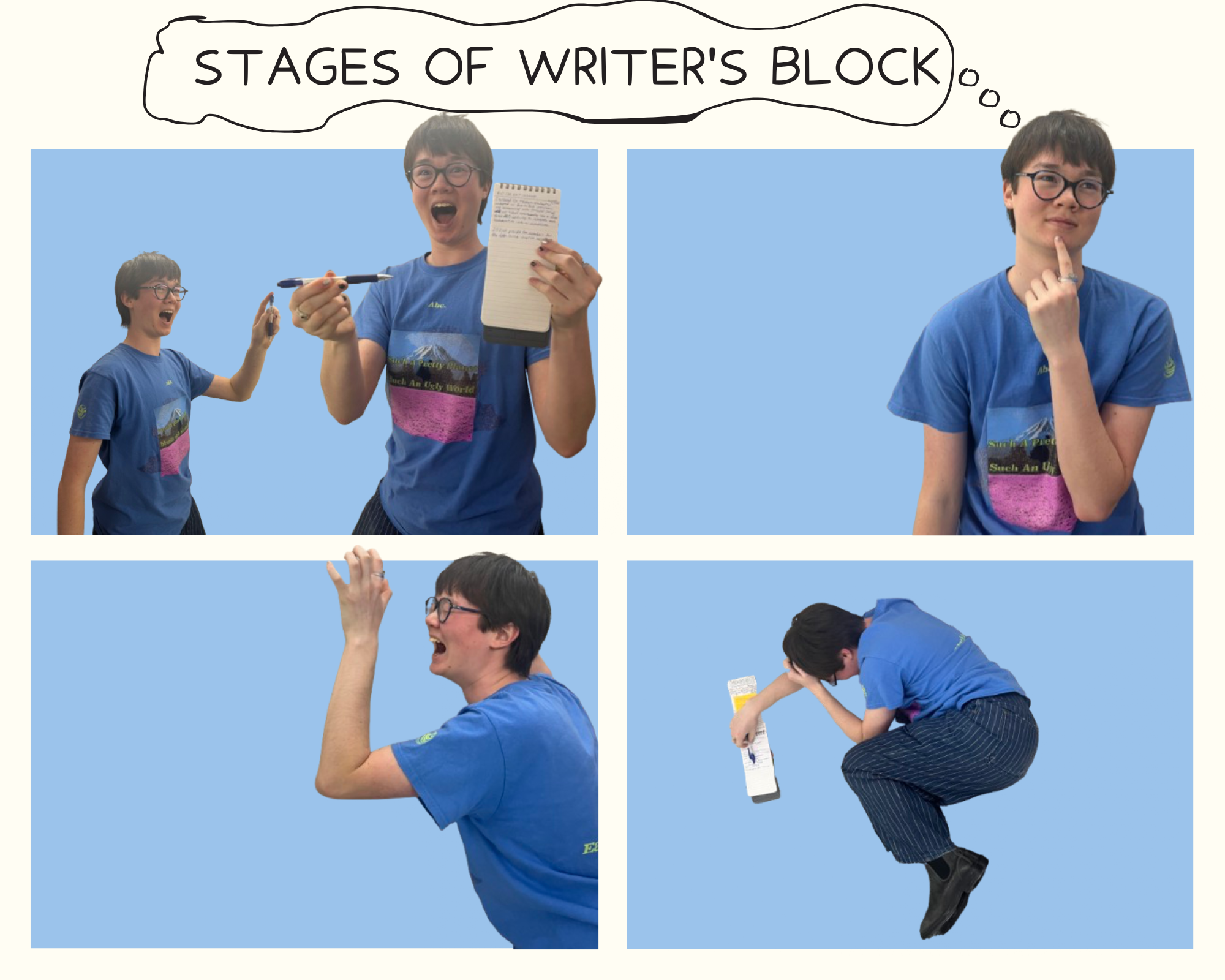
Writing is breathing. Don’t let anyone persuade you otherwise. See how the sentences swell and contract, punch and caress, dance and collapse?
If you’re a fellow syntactic fanatic, you might be familiar with a distinct terror, however, when confronting the blank page. I urge you to read the following patterns of writer’s block before it threatens your life.
Warning Signs
- You’ve been eagerly brainstorming this project for weeks—how hard could it be to just start? You sit down and open a Google Doc. Despite it only being the first draft, your personal, self-imposed editor keeps interrupting ideas to perfect diction and punctuation.
- After spending 60 minutes on one paragraph and being left with fastidious formatting and zero meaning, you begin to feel woozy. You manage to peck out a few more thoughts, which become increasingly vague and tangled.
- You take far too many breaks between clauses to indulge in the mind-numbing wonders of Block Blast and TikTok.
- Now, you fully relieve yourself of the torture of your keyboard. The wall becomes your muse! You pound it, then cradle yourself against it, then just stare intently at its texture because your disjointed words have imprinted themselves in your mind, and you can’t stop juggling the inarticulable.
- A passerby asks if you’re okay. When you try to logically explain your creative constipation, you realize you have lost the ability to speak. It’s fine, though—all you have to do is write the draft. Right?
- Instead of writing the draft, you writhe and sob in your bed, dreading the task ahead. You tire yourself out in hopes that sleep will consume your agony; instead, you dream that your editor curses you out for missing their deadline as they dangle you above a fire where your discarded sentences are kindling.
- When you wake up, it’s no longer only your vocal cords that are paralyzed: Every muscle in your body has become limp. Physically incapacitated, you’re now doomed to swap out hypothetical adjectives and have imaginary conversations with Gregor Samsa’s ghost for eternity.
Peer-Reviewed Guidance
- You are a human being, not a machine. Forgo elaborate technology and the notion that you are only worth what you produce. Make your thoughts tangible on paper; find pleasure in clicking your pen instead of watching the monotonous blinking of a cursor.
- Pick up an actual book (or even a printed newspaper). How dare you call yourself an aspiring novelist as you erode your attention span, blasting those terribly aesthetic blocks? You must study the craft before plunging yourself into it.
- Touch grass, please. Go to your nearest park and imagine all the people you’ve been while exploring its paths; each of them has overcome obstacles far greater than writing a first draft. Bring a notepad and headphones.
- Dangle your legs over a stone ledge, listen to your favorite songs, and feel the air rush through your lungs. Within 20 minutes, this should induce a state of hypnosis that reinvigorates your creativity, allowing you to brainstorm in entirely new directions. Jot down everything that arises.*
- Upon arriving home in your newly enlightened state, rip your brainstorms into individual slices of paper and passionately rearrange them to achieve the perfect progression of ideas.
- Once you’ve finalized your outline, banished all distracting family members from your surroundings, and soul-searched for 600–700 hours, it’s finally time.
- Write.
*The Achoo has independently confirmed the great efficacy of this technique for college essays. Read “How to Get Into Your Dream School [GUARANTEED]” for more information.