

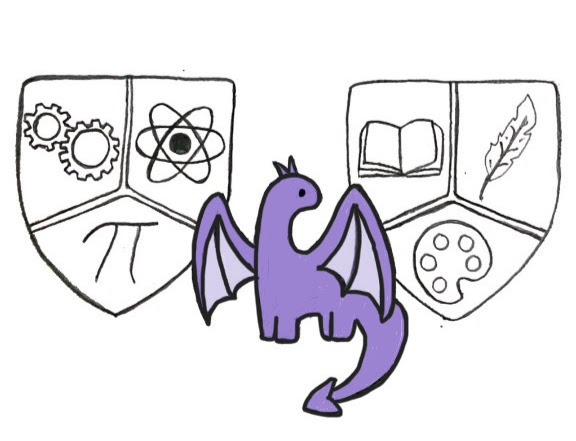
The spring of my sophomore year was filled with deliberation over which track I’d pursue for the rest of high school: math, science, or engineering. None of the options captivated me. Poetry recitations and Echo reporting adventures had been the highlights of my time as an underclassman—yet picking a STEM concentration was unavoidable. What was I meant to do? I filled out the track selection Google Form by the due date, wordsmithing something about a passion for numbers and math.
The math track turned out to be a poor fit for me. Although no individuals are at fault, I’ve struggled to find community and excitement in the classes offered. I also wish more of my peers acknowledged that regardless of academic preferences, STEM has a responsibility to society that can only be understood through the humanities’ lens. I would have loved a track aligning with my interests—but, as the humanities emphasize, there isn’t just one right answer, and rigidly separating academic disciplines from one another might actually hinder our learning.
After surveying over 50 teachers and students, conducting six face-to-face interviews, and corresponding with Principal Dolcy, I’ve found that I’m not alone. A significant portion of the MSE-ers I engaged with agreed that STEM needs the humanities, as creativity, critical thinking, and communication drive our development. Changing our curriculum to better reflect this is a legitimate possibility.
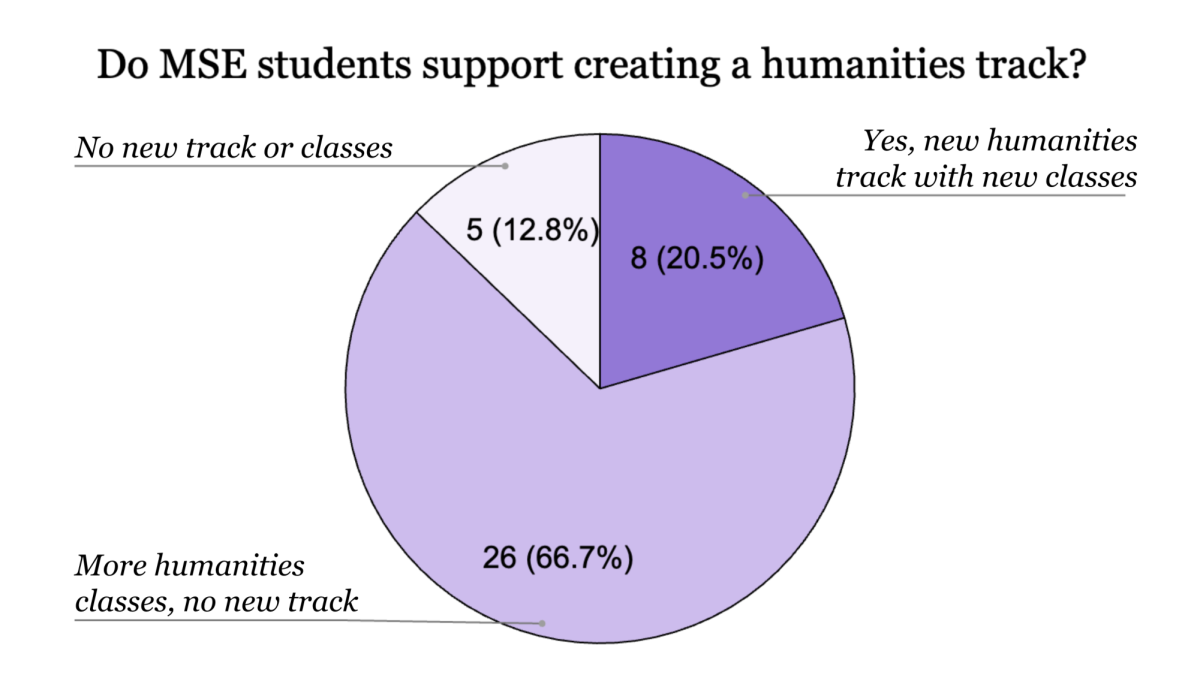
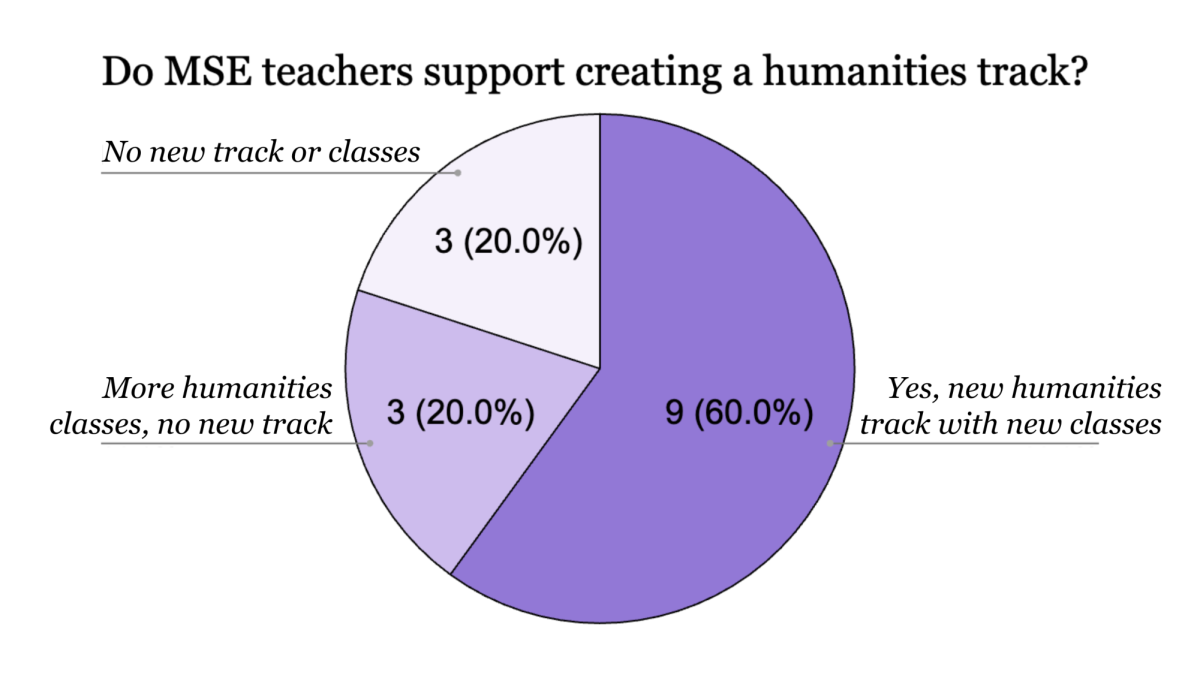
For the data-oriented skeptics out there, I’ll begin with the numbers. I polled 39 members of the Classes of 2025 and 2026 last June, when they had each completed at least one full year in a track. 34 of these students wanted more humanities classes, with 8 interested in a new humanities track. As for teachers, 12 of a sample of 15 supported adding more humanities classes, and 9 supported creating a humanities-based track.
The clear majority of surveyed MSE-ers, teachers and students alike, want more humanities classes to be offered. There would certainly be an audience: Even though we’re at a school for STEM, only 59% of surveyed students preferred it over the humanities. 15% preferred humanities over STEM, while 26% expressed no preference.
And though opinions on the creation of a humanities track are more varied, our administration is open to the idea. “It can happen—it’s just about finding the right teachers and students to make a plan for the track and give it some support and traction,” Principal Dolcy said.
Mr. Dolcy offered several approaches for implementing a humanities track. The minimum number of classes in a classic MSE concentration is just three (that’s what the math track currently has). He suggested that AP Psychology could be one—though classified as a social science, many of its topics are adjacent to the humanities. “Two additional humanities courses [could be] carved out from the electives or as proposed new courses,” he said. He did, however, acknowledge the potential constraints of staffing, money, and space.
The phrase “at the City College of New York” is appended to our school’s name. HSMSE is already partnered with CCNY’s College Now program, in which our students take dual-enrollment classes (such as Government and Calculus I) that earn them both high school and college credit. Mr. Dolcy said that the humanities track could potentially include College Now courses, which would not only avoid the obstacle of HSMSE’s staffing limitations but also bolster our relationship with CCNY’s campus. Several teachers I interviewed supported this idea: Ms. Walker saw it as “a way [to invest] in … really engaging with the resources and ideas that exist 20 yards from our front door.”
Ms. Hesseltine’s vibrant “dungeon” has been my literary and journalistic oasis for the past four years. “The critical thinking and the empathy that [are] integral to the humanities [are especially important for] high schoolers who are finding themselves and deciding what kind of people they want to be,” she said. However, she’s not sold on compartmentalizing our education into tracks; rather, she views them as an extension of how society unfairly pressures young people to affix themselves to rigid labels over savoring the organic process of self-discovery.
Indeed, we’re trained to value the outcome far more than the process. I spent the last year enduring (and analyzing) the agony-inducing rhetoric of college applications: Your future starts here. Our institution can personally guarantee you a six-figure income. The major you select will define your life, so choose wisely. Sound familiar? Notions of profitability have come to dictate which academic disciplines society values, and developing a deep understanding of the human condition is rarely quantifiable. As a result, many U.S. universities are quashing their humanities, arts, and social sciences programs, to the fury of students and faculty.
This obsession with efficiency also underlies why AI is being pushed so intensely, particularly at the expense of artists and writers. The journey of wrestling with my thoughts to craft a coherent, powerful piece of writing is often excruciating (I suffered through it while drafting this article), and I believe it’s what gives my work meaning. AI mimics form, but can never replicate the potency and rawness of human creation. The more we outsource our thinking to machines, the less we’ll be able to understand ourselves, interrogate systems of oppression, and live with agency—the very skills cultivated by the humanities.
“Sitting with uncomfortable thoughts and having to sort of walk down the path of an idea is really essential. AI takes that away,” Ms. Hesseltine said. “Sometimes living will be a struggle, and the strength and the understanding that arises out of that struggle makes you feel alive and gives your life value.”
STEM fields have suffered under society’s blind chase towards outcomes and profit as well. Research has found that engineering students’ concern for public welfare decreases over the course of their undergraduate education, because they are implicitly taught to separate technical knowledge from “softer” fields that center cultural and ethical considerations. This distancing of disciplines is incredibly dangerous: Engineers must be conscious of their responsibilities to the societies they innovate for. Algorithms alone cannot “solve” entrenched injustice.
But that doesn’t have to be the fate of all STEM-oriented students. Dr. Aleyasin, the leader of HSMSE’s Mt. Sinai Biomedical Science Enrichment Program, rejects the commonly accepted dichotomy between humanities and STEM. He encourages students in Sinai and science research to grapple with social issues: “In the beginning, [we] list world problems on the board. And then we sift through them and sort them out,” he said. After narrowing the number down to ten, the students use these world problems to guide scientific research projects, which they pursue in dyads for the entire year. “They have to think outside the box. And that is something that is encouraged.”
Mr. Modeste, our school’s new biology teacher, is studying teacher diversity issues in his Teachers College PhD program. “One side of teaching is about getting students interested in science and STEM careers. Once they get there, how do we prepare them to challenge some of the negative ways that science is used?” he said. He referenced how pharmaceutical companies are polluting communities of color and how scientific institutions have more often treated Black and Brown people as subjects than as decision-makers.
Both Dr. Aleyasin and Mr. Modeste expressed the importance of communication in science. After all, what is the value of your research if you can’t concisely and compellingly articulate it to audiences? A successful application to the Sinai program requires robust writing skills, and, in fact, every editorial board of The Echo since its founding has included Sinai students.
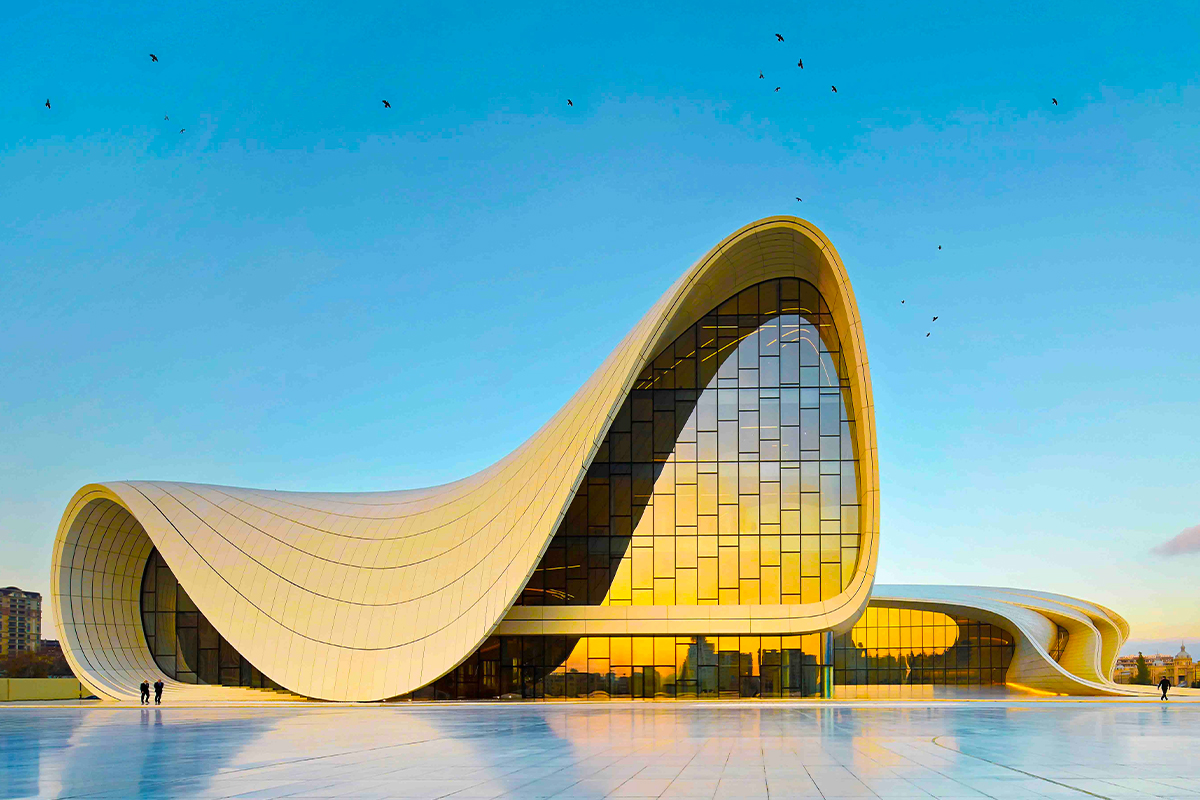
Ms. Rasuk embraces architecture as a wildly interdisciplinary subject. She introduced me to Zaha Hadid, who was a mathematician before becoming one of the world’s most renowned architects and designing the Heydar Aliyev Center, which strikingly resembles the cosine curve. “What I love about Zaha Hadid is that combination where you really see the mathematics being built, but she also really digs deep into the human experience,” Ms. Rasuk said. “Architecture needs to touch your soul, very similar to poetry.”
She has also found unexpected crossovers with STEM in AP Art History. “There are a lot of art history pieces that collide with either physics or mathematics and were actually trying to solve something,” she said. For example, Marcel Duchamp’s art explores the possibility of a fourth dimension.
From these interviews, it’s clear that STEM and the humanities are inseparable, and an interdisciplinary culture is already being fostered at our school. If the humanities were further integrated into our curriculum, they would, of course, primarily attract students like me, but they would also enrich the worldviews and contributions of those who intend to pursue STEM. Given the recent dismantling of the National Endowment for the Humanities and many colleges’ limited opportunities for students to explore beyond their majors, our high school has the opportunity to provide students with crucial knowledge that might be hard to access after graduation.
Interdisciplinary options wouldn’t necessarily have to entail creating a new track. A few teachers proposed directly integrating more humanities into the STEM tracks’ classes, which could be interesting to explore (though there would have to be sufficient student interest as well). If we were to continue with the current curriculum, Mr. Dolcy said a “humanities supplement” option could formally recognize students in STEM tracks who consistently choose humanities electives.
In addition to the teachers, I interviewed fellow student Lina Hobert (’28), who adores history but came to HSMSE seeking an education rigorous across all fields. “What’s great about having … very specialized classes is that you’re really able to explore a subject very deeply—and once you do that, you can also realize how much it intersects with [other fields],” she said. As a second-semester sophomore, Lina is currently deciding her track. She’ll most likely choose biology, noting its transferable skills (such as active recall) that can be applied to her other interests. When I asked whether she’d take a humanities track if there were one, she answered, “Yeah, definitely.”
I don’t mean to discredit the fact that the current track system does work for many students. The Mt. Sinai program is an invaluable opportunity that distinguishes HSMSE, and other specialized classes, from Digital Systems Design to Organic Chemistry, give interested students a real taste of advanced concepts not offered in most other high schools. “I like the track system because it forced me to take classes that I wouldn’t have chosen myself,” wrote Alyssa Chung (’25), who chose the engineering track, in a Google Forms survey. “I wouldn’t have chosen to take digital electronics because I didn’t understand what it was about. It ended up being one of my favorite classes last year.”
But for those whose tracks don’t suit them, it’s a big commitment—and at a competitive school, feeling unfulfilled and demotivated in the demanding classes occupying your schedule can be quite isolating. I’m still not sure how I survived junior year.
Many surveyed students and teachers expressed wishes for an “undecided track” or an option to switch tracks after the initial decision. I shared these ideas with Principal Dolcy. Regarding the first, he thought the electives already offer ample opportunities to explore across subjects; for the second, he said switching tracks is avoided due to logistical constraints, though extenuating circumstances can prompt exceptions.
Despite Lina feeling that HSMSE hasn’t really supported her passion for history, she had an optimistic take: “I honestly think that’s been a good thing, because it has prompted me to look for opportunities elsewhere,” she said. After pulling some strings last fall, she was able to enroll for the AP European History exam at a different school; she’s simultaneously self-studying that course and taking AP World here.
Her experience reminded me of my gratitude for The Echo, which I sometimes joke is my real track. My high school experience will always be defined by the community and purpose I’ve found in the newsroom. I’ve not only learned writing and editing, but also leading, persevering, and devoting myself to a process that invigorates our school (even if I’ve occasionally felt isolated from the words comprising it) every distribution day.
HSMSE has helped me appreciate the mathematical logic underlying sentence structure, the scientific inquiry driving rigorous journalism, and the engineering behind crafting a beautiful newsstand. Next fall, I’ll be at Reed College, which is known for its rigorous humanities requirement and nonconformist students; a few years later, maybe I’ll return to a Baskerville Hall whose curriculum finally allows younger versions of me to thrive.